Faith Ringgold’s *The Invisible Princess* depicts complex themes of race and identity, challenging traditional fairy tale narratives through vivid imagery.
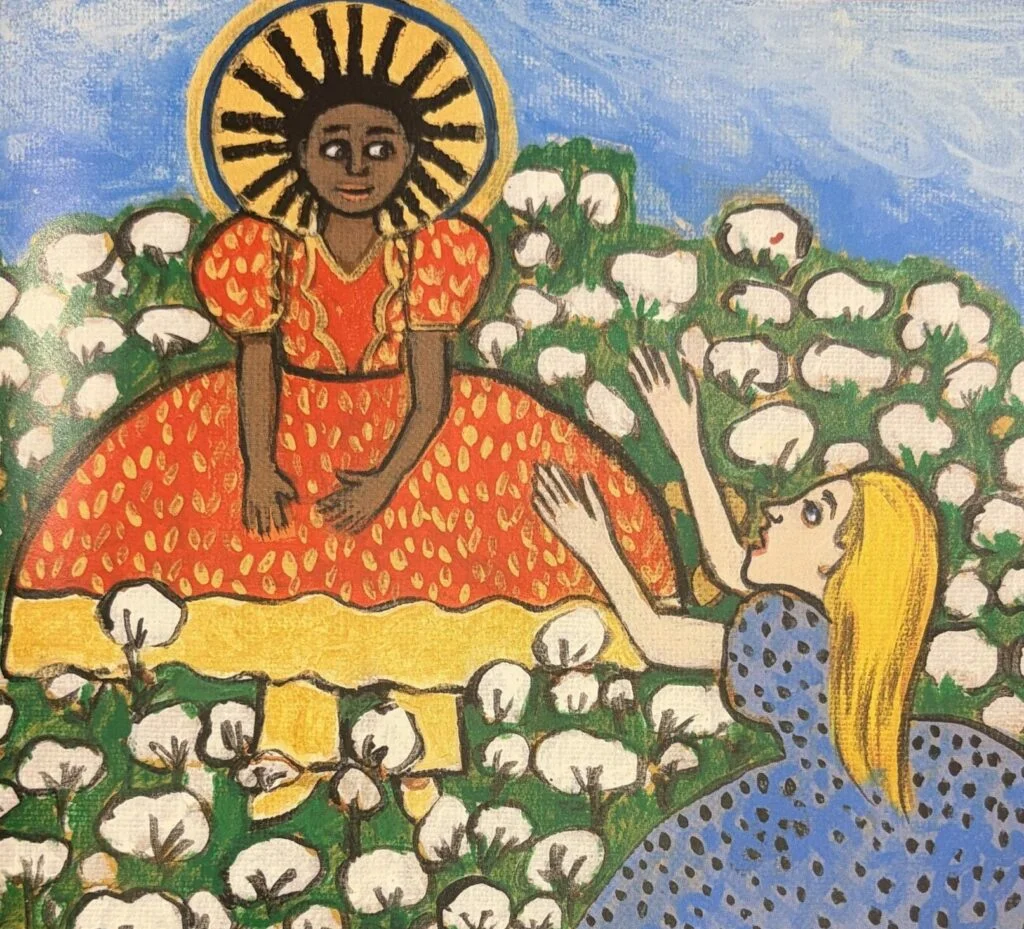
Faith Ringgold's *The Invisible Princess*, a 1998 fairy tale, reshapes the narrative landscape of children's literature with its poignant themes and vivid illustrations. It tells the story of two families—Patience, the blind daughter of a slave owner, and the titular Invisible Princess, born to enslaved parents on Captain Pepper’s plantation. The book cleverly intertwines the harsh realities of slavery with an imaginative arc that captures the essence of childhood innocence amidst deep social commentary.
The narrative introduces Princess Love, a child whose existence is shrouded in invisibility, bestowed upon her by the Prince of Night for her safety. Her parents, Mama and Papa Love, had refrained from having children due to the grim fear of them being sold into slavery. Yet, the Great Lady of Peace assures them that their child would be a beacon of hope—a princess destined to elevate the spirits of the plantation. This haunting premise sets up a rich emotional framework that Ringgold explores through her distinctive artistic style.
What's striking about Ringgold's illustrations is their uniformity across characters; the expressions don’t vary much, leaving interpretations open-ended. The villain, Captain Pepper, and the benevolent Great Lady of Peace share a similar gentle smile, prompting young readers to question conventional designations of good and evil. The Invisible Princess is described as the most beautiful princess, yet her depiction is subtly integrated with the other characters, blurring the lines between beauty and ugliness in their social contexts.
Ringgold adeptly presents two contrasting worlds: the Village of Visible, rife with suffering and slavery, and the Invisible Village, a utopia of peace and love. The imagery in *The Invisible Princess* is like a vivid tapestry where the background and foreground coexist fluidly—patterns of cotton fields merge with the dresses worn by the characters, encapsulating an eerie sense of harmony that reflects the difficulties faced by the slaves. This visual storytelling style presents themes of good and evil subtly, allowing children to feel rather than explicitly define these concepts.
One particularly striking scene illustrates the plantation's deceptive beauty. With imagery of well-dressed white individuals indulging in luxuries, the stark truth of enslaved children laboring in cotton fields underscores the bitter reality of inequality. Ringgold’s text poignantly highlights the superficial beauty built upon the suffering of others, forcing readers to confront the uncomfortable aspects of history that are too often glossed over in children's narratives.
As a child, the visual absence of enslaved quarters contrasted sharply with the beautifully appointed plantation house, stirring curiosity about the untold stories of those who lived in those unseen spaces. This absence of representation invites contemplation about the harsh realities of slavery and fosters an understanding of history that isn't solely rooted in romanticism.
Another powerful memory for the author emerges from visiting the Underground Railroad museum, where experiences of role-playing runaway slaves create lasting impressions. The visceral nature of the simulation, though frightening, is emblematic of a reality that is frequently sanitized or omitted in discussions about history, emphasizing the need for a deeper understanding of the past.
The climax of *The Invisible Princess* presents a resolution that is both eerie and enlightening. The characters find themselves needing to sacrifice their earthly lives to access the Invisible Village. This disconcerting conclusion—where becoming invisible involves pain and sacrifice—creates a chilling tale of resilience and rebirth, leaving readers to grapple with the implications of such an escape. The community of slaves must first endure suffering before they can attain freedom and peace.
As Captain Pepper seeks Patience in a now-deserted plantation, he realizes the futility of his quest. The book concludes with a subtle shift in expressions; the characters’ smiles widen, reflecting a newfound sense of liberation, albeit at a grave cost. In reflecting on the haunting beauty of the story, it becomes clear that the transition from suffering to peace is steeped in layers of meaning.
Upon revisiting the Underground Railroad museum, the exhibits now feel distant and sanitized compared to childhood memories. An encounter with a reconstructed barn for holding slaves—a chilling yet important part of history—reveals truths that provoke introspection about the legacy of slavery and its representation in societal narratives.
Asha Futterman is an actor and poet. Her book Song of Gray won the Colorado Prize for Poetry. Her poem “Study of Children” appears in our new Fall issue.
Discussion
Sign in to join the discussion.