Exploring the Poetic Depths of J.H. Prynne: A Legacy of Complexity and Craftsmanship
Published Oct 07, 2026574 readers
J.H. Prynne's poetry, marked by intricate syntax and rich imagery, challenges readers and shapes contemporary literary conversations, emphasizing the power of language.
The Enduring Legacy of J.H. Prynne
J.H. Prynne's literary journey encapsulates an extraordinary command of the poetic form, making his work both a challenge and a revelation. For those engaged in contemporary poetry, the nuances of Prynne's writing are essential to understand not just his contribution, but also the conversations currently shaping the genre.
There’s a certain enchantment in discovering Prynne’s poetry tucked away in the basement of the London Review Bookshop. It’s where you'll find these rare chapbooks, each meticulously crafted, yet concealed from the casual reader—perhaps as a defense against theft. This charming speaks to a broader truth: Prynne's work—often difficult yet rich in its complexities—demands attention and commitment, qualities that can seem elusive in the current literary climate.
My first encounter with Prynne came as a revelation that reignited my passion for poetry during a particularly uninspired phase. Reading his *The White Stones* was akin to rediscovering the limitless possibilities of language—to feel wonder at thirty-three, reminiscent of spotting brilliance in *The Waste Land* at fourteen. What compounded this joy was the knowledge that even in his late eighties, Prynne was still actively producing poetry, with more pages lying ahead than behind him. This ongoing creative flow is reminiscent of other late-career literary figures but holds a unique place within British poetry.
Yet, despite my admiration for his writing, I found it curious that my interest in the poet himself trailed the passion for his work. Most of what I knew about Prynne was conveyed through the text; personal details arose sporadically, like whispers in a crowded room. His early career is littered with intriguing stories—an enigmatic figure who has corresponded with other literary giants, yet remains shrouded in privacy. News of his declining health barely grazed my comprehension until he passed away in April 2026 at the age of eighty-nine. It was only then, through a slew of obituaries and retrospective discussions, that I began to unravel the complexities of his life and mind.
After his death, I felt compelled to revisit the clandestine shelf at the bookshop, a pilgrimage to the haven of his final works. I devoured *Which Scarf Match* and *Single Tangle Mine* aboard a flight, the latter being the concluding chapter of a poet whose influence far exceeds the breadth of his years. The final poem, “Foxglove Alimony,” caught me off-guard. There was no bittersweet finality, as one might expect from a creative funeral march. Instead, the realization dawned that no one, least of all myself, might fully grasp the expansive intricacies of Prynne’s intellect—not in a long while.
In the realm of poetry, difficulty can often terrify readers. Prynne’s work, steeped in intricate syntax and eclectic vocabulary, seemingly resists simplistic interpretation. The allure for me resided in that challenge; it was an entryway into a world of thought and philosophy I had long wished to explore. His early poems exemplified a mastery of language, juxtaposing abstract ideas with concrete images, pulling from disciplines as varied as geology and economics.
Yet, as the poet’s career evolved, he continuously escalated the stakes. His subsequent collections dared readers to wrestle with their own interpretative frameworks, pushing boundaries that many would find daunting. The complexity of *The Oval Window* baffled critics until a concerted effort shed light on its obscure references, from classical literature to modern technical manuals. Each work demanded a rethinking of one’s own reading strategies, urging engagement with his labyrinthine verse.
By the time “Foxglove Alimony” arrived, Prynne had stripped away conventional grammatical structures, leaving behind a tapestry of words that felt far removed from traditional poetic constructions. The lines adhere more to a sonic quality than to semantic clarity, challenging us to redefine what it means to read poetry—an idea that flickers tantalizingly, like the fleeting essence of the foxglove itself. It’s a dance of language that requires both a willingness to embrace difficulty and a recognition that clarity might remain just out of reach.
As we grapple with Prynne’s final collection, it’s worth pondering what “Single Tangle Mine” might mean in its intricate potentialities—a conflation of personal and abstract themes. The patterns of language he incorporated lead to a deeper understanding of not only the poet himself but also of the potential paths forward for poetry as a living form. With his passing, we are left not with closure but with an invitation: to keep digging through the layers of Prynne’s work, because in those tangles, there lies an abundance of meaning yet to be mined.
The Significance of Materiality in Prynne's Work
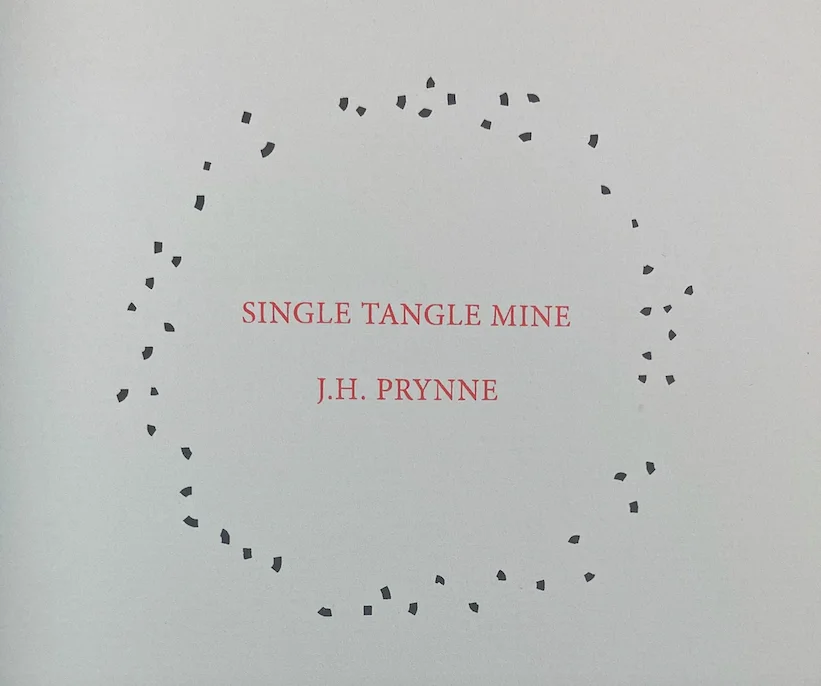
At a glance, the poetry of J.H. Prynne may seem nestled within the confines of language alone; however, both Wheale and Beci Carver make compelling arguments that the physical characteristics of the printed format are equally crucial to the experience of his work. Take, for instance, the white cover of *Single Tangle Mine*, adorned with a distinct circular pattern formed from tiny black flecks. This motif doesn’t just serve an aesthetic purpose—it resonates throughout the text, reappearing at the end of *Foxglove Alimony*, depicted within a whimsical illustration that captures a bird, suggesting layers of meaning and connection.
While exploring the artwork on its cover, I reached out to Ian Heames, the publisher behind *Single Tangle Mine* and other Prynne chapbooks, seeking to understand its origins. He shared that the image is based on a *riggiola*, a hand-painted majolica tile from the esteemed Neapolitan pottery house of Giustiniani, likely crafted in the eighteenth century. He found it on eBay, a rather unexpected venue for such a remarkable piece, yet its selection was deliberate. “It immediately staked a strong if somewhat occulted connection with the title of the book and the phoenix with which it ends,” he explained, adding that the bird's posture struck him as “oddly comic,” evoking the idea of “sawing off the branch you’re sat on.”
Digging into the tile’s backstory, I discovered that Nicola Giustiniani drew inspiration from the vibrant designs that adorned the walls and floors of recently unearthed Pompeian villas, tragically buried under volcanic ash when Mount Vesuvius erupted in 79 A.D. This event not only led to the loss of countless lives—including that of the notable Pliny the Elder, who bravely attempted rescue efforts from the clutches of nature—but also resulted in significant historical documentation. As Pliny penned his *Naturalis Historia*, a monumental text outlining the scientific knowledge of his time, he unwittingly captured a moment poised between destruction and immortality. This interplay of life, death, and resurrection resonates in the cover image of *Single Tangle Mine*, which Heames poetically referred to as a wreath. Unlike traditional wreaths of triumph or remembrance, it evokes the concept of ash—symbolizing endless cycles of creation and obliteration.
Conclusion: Embracing the Interconnectedness
What does all this tangential exploration mean for readers and scholars of Prynne? It's a reminder that poetry doesn't exist in isolation; it interweaves with history, art, and the tangible world. Exploring these connections enhances our understanding of the text. If you’re engaging with Prynne’s work—or any literary art form—it pays to consider not just the words but also the material and visual components that surround them. They enrich the narrative, infuse it with depth, and provide a more comprehensive lens through which to appreciate the poet’s intricate tapestry. So the next time you pick up a volume, consider not just what's on the page but also what the book itself—its design, its materials—has to say.
Discussion
Sign in to join the discussion.