A century after its publication, Hemingway's own account of writing The Sun Also Rises shows a novelist who struggled with paragraphs and then wrote fast.
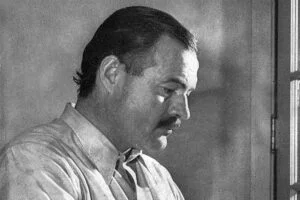
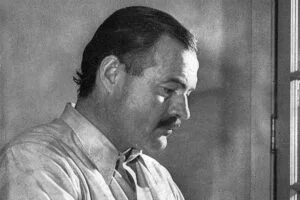
Ernest Hemingway, ca. 1939. Photograph by Lloyd Arnold, courtesy of Wikimedia Commons.

The most revealing thing about The Sun Also Rises may be how little Hemingway seemed to expect from himself at the start. Speaking with George Plimpton for The Paris Review's Art of Fiction series, he said he began the novel in Valencia on his birthday, July 21. “Everybody my age had written a novel and I was still having a difficult time writing a paragraph.”
That's a striking admission from a writer who'd go on to be read as one of the most recognizable stylists of his era. He isn't complaining about talent here. He's describing a feeling most writers keep to themselves, the sense that everyone around them has already crossed a line they're still circling. If you've ever compared your early drafts to someone else's finished work, you'll recognize that feeling immediately, and you'll probably recognize how little it helps.
A Stall That Finally Broke
The gap between that struggle and the result is the interesting part. By his account, the first draft took about six weeks. That reads less like a sudden gift and more like a long stall that finally broke.
It's tempting to romanticize a book like this as something that poured out in a rush. The account Hemingway gives is more mundane, and to my mind more useful. Six weeks is a short window for a novel, but it's a long time to sit with a page that won't cooperate. Most of the real labor, in other words, happened before the sentences started behaving.
Writers who've hit this wall often describe a similar pattern: long stretches of nothing, then a stretch where the sentences suddenly obey. I'd treat that as general framing rather than evidence about Hemingway specifically, since the interview doesn't map his days in detail. Still, the pattern is familiar enough that it's worth remembering. If you're stuck on something right now, the stall may be part of the process rather than proof you've failed.
Asch's Skepticism
He showed the draft to the novelist Nathan Asch, whose accent Hemingway recalled as strong. That detail is the kind of small, human specific that makes an anecdote feel lived-in. It also tells you Hemingway isn't reporting from a polished memory of a triumphant moment. He's recalling a friend's reaction in a voice that still sounds a little amused.
Asch's reaction, as Hemingway told it, was blunt: “Hem, vaht do you mean saying you wrote a novel? A novel huh.” The line is almost dismissive, and that's what makes it land. Read plainly, Asch is asking whether someone who's just spent weeks wrestling a paragraph has any business calling a finished manuscript a novel. That's a fair question, and it's the one every first-time author quietly asks themselves.
The anecdote doesn't say how Hemingway took the jab. The book's existence suggests he didn't stop, and that's the only conclusion the source really supports. I'd be wary of reading too much redemption into the story, though. A skeptical reader friend is useful precisely because they refuse to flatter you.
Money, Worry, and the Work
October 22 marked the book's centennial, and The Paris Review has made its Art of Fiction No. 21 interview free to read this week. It first ran in issue no. 18 (Spring 1958). Anniversaries are a good excuse for republishing, and a free interview is a generous gift to readers. Still, I'd read the timing as a convenience rather than the reason the interview matters. Its value doesn't depend on the calendar.
Asked whether financial security can hurt good writing, Hemingway gave an answer that still holds up. The question sounds like something an interviewer asks to fill a slot. His response is more specific than that, and far more interesting than the usual advice on productivity. Here's the exchange:
INTERVIEWER
How about financial security? Can that be a detriment to good writing?
HEMINGWAY
If it came early enough and you loved life as much as you loved your work it would take much character to resist the temptations. Once writing has become your major vice and greatest pleasure only death can stop it. Financial security then is a great help as it keeps you from worrying. Worry destroys the ability to write. Ill health is bad in the ratio that it produces worry which attacks your subconscious and destroys your reserves.
From issue no. 18 (Spring 1958)
Here's the thing: most writing advice fixates on discipline and output. Hemingway's point is that worry is the real obstacle, and a century on, that's a sharper diagnosis than most productivity advice you'll read this year. Notice the conditions he attaches, though. He's talking about financial security that arrives early enough, paired with someone who loves life as much as the work. That isn't a blanket endorsement of comfort. It's a narrower claim, and I think it's more honest than the inspirational line most writers hear.
And yet the narrowness is exactly what gives the argument its bite. Worry, in his telling, is not a character flaw you can grind out with willpower. It's a drain on the subconscious, and the work suffers whether you're lazy or tireless. If you're a writer who's constantly calculating rent against the next draft, that observation probably lands harder than any word-count target. If you're already comfortable, it's a reminder that comfort doesn't guarantee the work will happen.
Why It Still Reads as Relevant
Archival interviews like this one tend to outlast the reviews of the books they discuss. That's partly because the questions are about process, and process doesn't date the way opinions about a particular book do. A writer in any decade can recognize the stall, the comparison, and the nagging worry about money. The specifics change, but the emotional mechanics stay surprisingly stable.
Here's where I'd push back on the enthusiasm, though. It's easy to treat a single interview as a manual, and that's a mistake. Hemingway was describing his own circumstances, temperament, and habits, and those don't transfer cleanly to anyone else. The useful takeaway isn't a formula. It's the willingness to admit that the struggle is ordinary and that worry is a real cost you'll need to account for.
What this means for you depends on your situation. If you're in this space, read the full interview rather than the quotes that circulate on social feeds, because the context around the worry passage is where the nuance lives. The reprint is a useful reminder that the best writing advice often comes from people describing what actually happened to them, not from people selling a system. That's a standard worth holding on to, even when the advice is a century old.
Discussion
Sign in to join the discussion.