Salon made fast, free online journalism feel possible. Its closing marks the end of an early experiment whose habits still shape digital publishing.
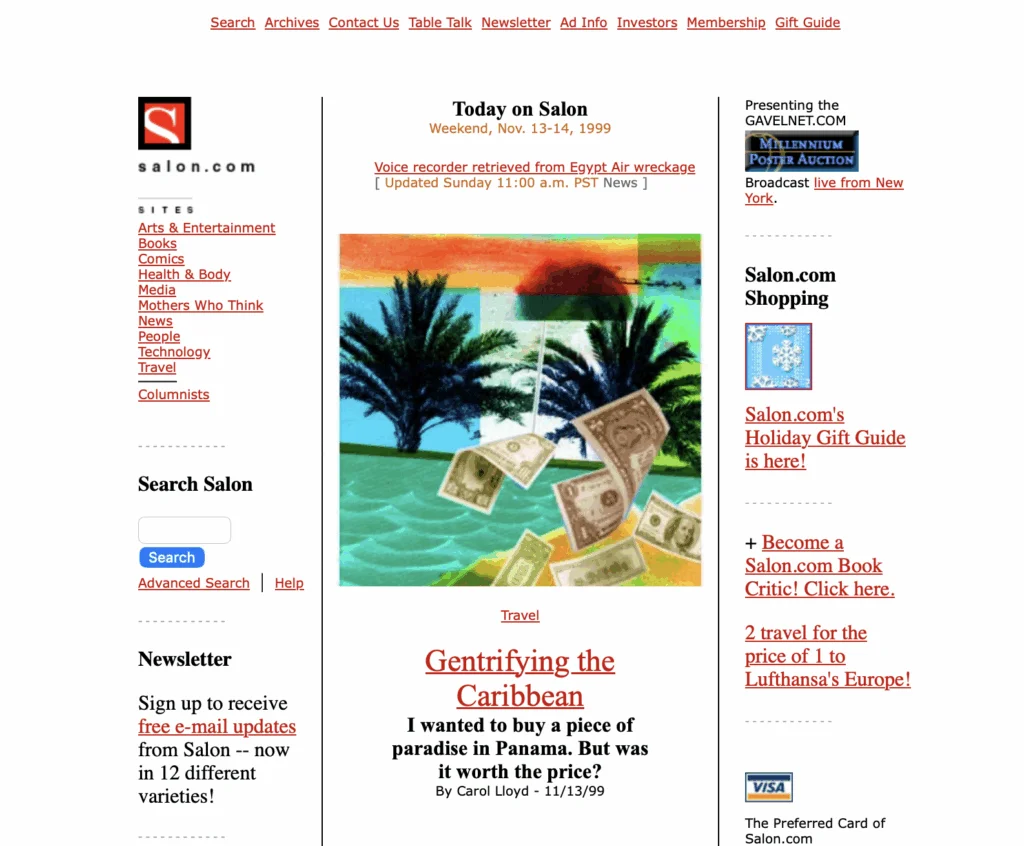
The home page of Salon’s website in November 1999.
Salon’s legacy is bigger than the website that has now closed: it helped make speed, personality and a steady stream of stories feel like natural features of journalism online. For writers who had spent their careers waiting for print schedules, that shift was immediate. The economics behind it proved far less durable.
A magazine without the paper
When Salon launched in the fall of 1995, its digital form unsettled assumptions about what a publication was. James Marcus, then a freelance journalist in Portland, Oregon, encountered a site that looked and read like a magazine: lively graphics, considered typography and prose that was sharp and willing to challenge conventional views. The surprising part was that readers could access it for free.
Marcus had a computer and a CompuServe email account, but freelance work still moved at the pace of the postal service. Writers sent manuscripts to editors, and the finished work eventually appeared on paper. A computer had mostly replaced the typewriter; it hadn’t yet transformed the business around it. Salon made that older workflow look suddenly optional. Marcus even printed out a piece about The Beatles Anthology, which was airing on television at the time, as if paper were still needed to make an online story feel real.
The publication had been started by former staffers from the San Francisco Examiner, journalists looking to build something outside the usual print mold. Its identity combined a left-leaning outlook with a libertarian streak and no obvious party line. That independence mattered. Other early digital publications had corporate parents: Slate belonged to Microsoft, while Mr. Showbiz was part of Starwave, a multimedia platform founded by Microsoft cofounder Paul Allen.
Salon had received $60,000 in seed funding from Apple, followed by $2 million from Adobe cofounder John Warnock and other investors. It operated as an independent publication, without a larger corporate owner whose interests might shape its editorial decisions. The format and ownership gave it room to sound different from established magazines, while its online distribution let it publish on a new timetable.
From publishing schedule to fire hose
For Marcus, the most startling change was how quickly an assignment could reach readers. Editor Dwight Garner sent him books for short reviews, and pieces appeared online almost as soon as they were finished. At times, Marcus was asked to send copy directly to the copy editor to shave more time from production. In print, a writer might wait for publication; at Salon, the interval could shrink to hours.
That quick turnaround became part of the publication’s pitch. Founder David Talbot called it a “smart tabloid,” and within months it was publishing daily rather than weekly. The approach favored stories while they still felt timely. It also helped establish the fire hose rhythm now familiar across digital news: frequent updates, short deadlines and writers expected to respond quickly.
Marcus started with books, then moved into music coverage assigned by television critic Joyce Millman. He wrote about Prince, Los Lobos, Bill Frisell and Cassandra Wilson—artists he cared about, rather than subjects chosen simply to fill a coverage slot. He also pitched an essay on Martin Scorsese’s use of music, describing the Casino soundtrack as what the director might listen to “if he were shipwrecked with nothing but a polyester suit and a bank of slot machines.”
Personal essays became another part of his work. One recounted being fooled by the supposed founder of the Church of Kurt Cobain, an organization that didn’t exist. Another described becoming absorbed in All My Children during a family health crisis, drawn to the soap opera’s peculiar resilience. These pieces ran alongside assignments on topics such as dental malocclusion and aluminum smelting. The variety and pace gave Marcus a sense of working inside a new kind of publication.
Speed outlasted the business model
The rapid publishing model did not translate into generous freelance pay. Marcus’s checks still arrived by mail, and the money remained modest. About a year after he began contributing, financial pressure led him to accept a job at Amazon, then a small startup he expected might fail within a year. He moved from Portland to Seattle in a diesel truck, leaving the unstable particle-board desk behind.
The habits he had picked up at Salon carried into the new job: write quickly, cut the copy and keep moving. At Amazon, he recalls supervisors arguing that a 150-word book review was too long. The compression demanded by digital publishing had become part of the broader working culture around online media and retail.
His relationship with Salon later became entangled with the commercial alliances that could complicate editorial ties. The magazine entered a corporate arrangement with Borders, and Marcus felt that his Amazon job made him a traitor to the publication. He had encountered a similar tension when the New York Times Book Review partnered with Barnes & Noble; an editor told him, “I’m afraid you’re on the other team now.”
By 2004, after leaving Amazon, Marcus returned to Salon in a different capacity. The magazine published a long excerpt from his book Amazonia alongside a favorable review. He read the attention as a quiet recognition of his earlier contribution, even though he had stopped writing for the site.
The cost of free access
Salon’s business model rested on the hope that digital advertising could support journalism offered without a subscription price. That expectation failed to hold. The dot-com boom’s soaring valuations also gave way. When Salon went public in June 1999, its valuation was $107 million. An editor later recalled the celebrations: “We danced around the living room and said, ‘We’re rich, we’re rich!’”
Two decades later, in 2019, the publication sold for $5 million to two entrepreneurs. They later passed it on for a small sum to a Malta-based company describing itself as a “performance marketing ecosystem,” whose website is strongly oriented toward cryptocurrency. Salon has now closed its doors.
That trajectory captures a difficult tension in early digital publishing. The technology made it possible to distribute journalism quickly and freely, while the business model struggled to replace revenue from the physical product. Salon demonstrated how much editorial energy the format could release; its history also shows that audience access and a viable publishing operation are separate problems.
What remains in the archive
For Marcus, the closure carries a personal weight. His work for Salon belongs to an earlier stage of his career, and the prospect of those pieces disappearing makes the loss feel less abstract. He plans to search the archives for his contributions and print them out.
That instinct is telling. A publication that once made paper seem like an unnecessary step may now be remembered through paper copies rescued from its digital archive. Salon helped normalize a faster, more personal style of online journalism, but its closing brings the fragility of that work into view. The stories may have been published instantly; preserving them still takes deliberate effort.
Discussion
Sign in to join the discussion.