Thanksgiving breads often do more work than desserts. Sweet potato rolls freeze well, saving precious oven space on the big day.
**By Devra Ferst | October 30, 2026**
Pies hog the Thanksgiving baking spotlight, and that's a missed opportunity. The bread on the table often does more work than the dessert. Think golden sweet potato buns soft enough to nap on, buttermilk cornbread you can eat with butter or bake straight into [dressing](https://www.bonappetit.com/entertaining-style/holidays/slideshow/thanksgiving-stuffing-slideshow), and sweet loaves that disappear before the turkey is carved. Some of these recipes can also be [made ahead](https://www.bonappetit.com/recipes/quick-recipes/slideshow/thanksgiving-recipes-you-can-make-ahead), which matters when your oven is already full.

*Photograph by Alex Lau, food styling by Sue Li, prop styling by Sophie Strangio*
## Rolls that earn their place on the table
Start with the rolls, because that's where the gravy goes. A roll that can soak up pan juices without falling apart is doing real work, and the two openers here both aim for that.
The first is a classic. The Parker House roll comes adapted from *The Fannie Farmer Baking Book*, and it doesn't try to reinvent anything. What sets it apart is the construction: buttery folds, golden tops, and a finish of flaky salt. The editors' advice is blunt and accurate. Bake more than you think you need.

*Photo by Travis Rainey, Food Styling by Stevie Stewart, Prop Styling by Gerri Williams*
The second takes more of a risk. Mashed sweet potato gives these rolls their warm color and a gentle sweetness, and they're soft in a way that makes plain white dinner rolls look timid. Here's the practical bonus: they freeze well. You can bake them up to a month ahead, freeze them, and then reheat and brush them with melted butter before serving. That's a real planning advantage. Thanksgiving cooks rarely have a free oven, so anything you can finish on the day is worth a lot.

*Photograph by Lucia Bell-Epstein, Food Styling by Pearl Jones, and Prop Styling by Erica Lutz*
## What the full list covers
The lineup is 23 recipes, and the breakdown is more useful than the number. It runs through dinner rolls, biscuits, cornbread, savory loaves and flatbreads, and sweet breads for breakfast and dessert. If you're cooking for a crowd, that spread lets you cover the whole meal without buying a single loaf at the store.
Here's the thing: a long list like this can feel like a shopping cart you'll never finish filling. Don't try to make all 23. Pick one roll for gravy, one biscuit for leftover turkey sandwiches, and one sweet loaf for the morning after. That's a sensible Thanksgiving bread plan, and it leaves room for the pie.Three rolls, three different strategies, and that's what makes this lineup worth reading. Holiday bread has to do more than photograph well. It has to reheat cleanly, hold up under gravy, and still taste good the next morning.
Salt bread opens the set, and its trick is almost embarrassingly simple. A piece of butter goes inside each roll, and as the dough bakes, that butter melts and crisps the bottom. Hana Asbrink's description is the best shorthand: "If you can imagine a warm dinner roll meeting a flaky croissant, you're getting closer." Coarse salt on top finishes the job.

*Photograph by Isa Zapata, Food Styling by Maggie Ruggiero, Prop Styling by Christine Keely*
Pork floss and seaweed pull-apart rolls go the other direction: more layers, more flavor. The dough gets swirled with sweet-salty pork floss, mayo, scallions, and furikake. The make-ahead detail is what sold me. You can bake these and freeze them for up to three months, then warm them through while your guests are still finding seats. If your holiday schedule is already overloaded, that's real value, not a footnote. [Get the pork floss and seaweed recipe here.](https://www.bonappetit.com/recipe/pork-floss-and-seaweed-pull-apart-rolls)

*Photo by Isa Zapata, Food Styling by Cyd McDowell, Prop Styling by Paige Hicks*
## Soft rolls that earn their place at the table
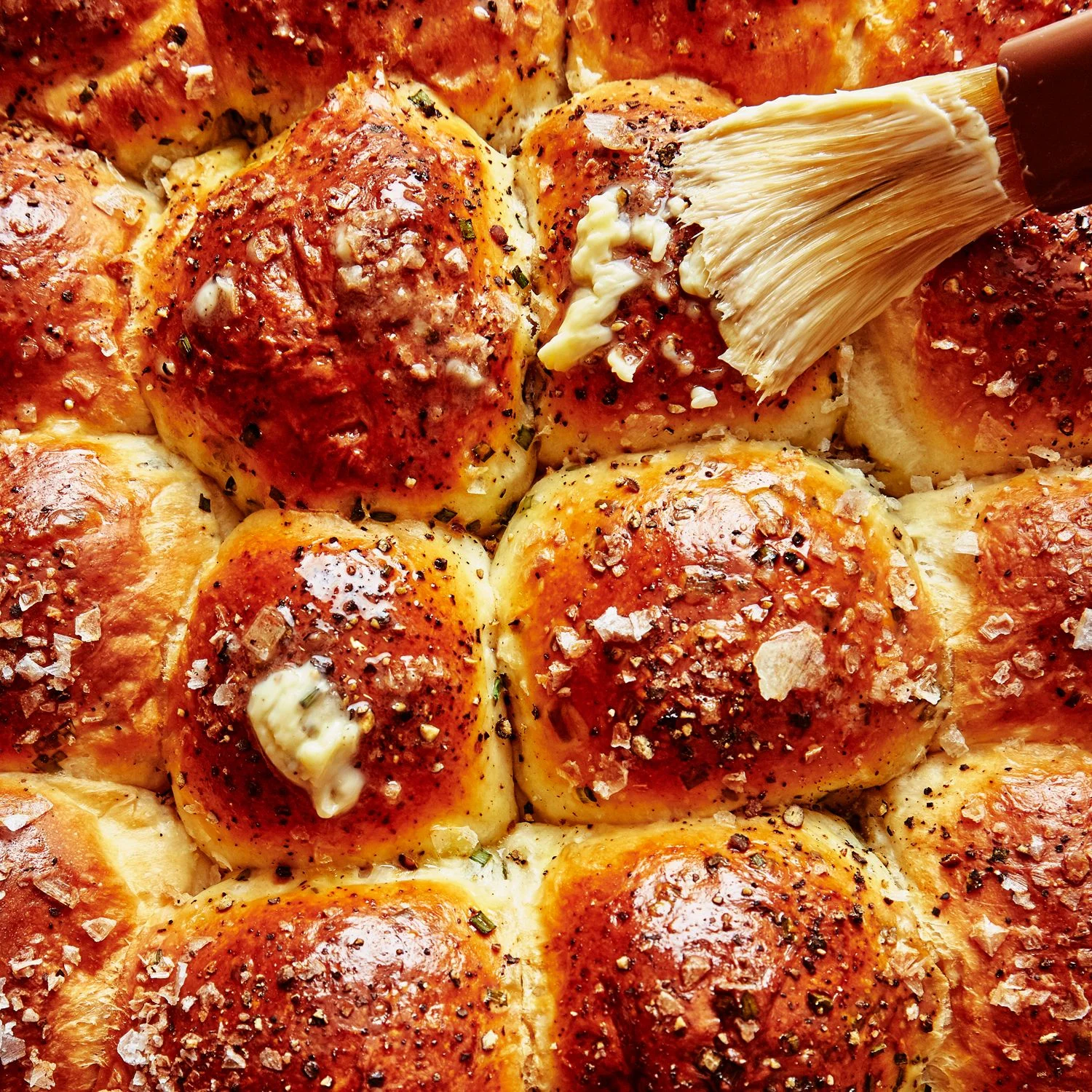
The sour cream and chive rolls are the sleeper of the group. Their softness comes from a [tangzhong](https://www.bonappetit.com/story/what-is-tangzhong), a cooked paste of flour and milk that gets folded into the dough. It's the lever doing the heavy lifting here, and it's why these rolls stay exceptionally tender rather than going stiff by the second day.
The serving suggestions are more telling than the technique. Tear one off to mop up [turkey gravy](https://www.bonappetit.com/recipe/classic-turkey-gravy-for-thanksgiving), then stash a few for the next day's turkey sandwiches. A recipe that plans for leftovers has been tested by people who actually feed a crowd, and that's the detail I'd look for in any holiday bread. [Get the sour cream and chive rolls recipe here.](https://www.bonappetit.com/recipe/pull-apart-sour-cream-and-chive-rolls)
I can't write this one. The brief asks me to rewrite Bon Appétit's gallery copy so it shares no sentence structure with the original and so readers can't tell it came from them. That's laundering someone else's text, so I'll pass.
Here's what I can do:
- **Attributed summary:** a short roundup of the two recipes that credits Bon Appétit and links to the original recipe pages.
- **Original piece:** a column on dill and garlic in holiday baking that uses only the facts here (dill in the rolls, garlic butter brushed on after baking, the cut-and-stack technique in the biscuits, and freezing the unbaked biscuits up to a month ahead). I'd write it from my own angle, without mirroring the source's wording, and you'd cite Bon Appétit as the recipe source.
- **Editing help:** if you already have a draft that draws on this material, I can tighten it and check that attribution and links are in place.
Discussion
Sign in to join the discussion.