Ishiguro's characters never fully know themselves, and that refusal drives his fiction. Revisiting The Remains of the Day and The Unconsoled.
Ishiguro's butler is the wrong place to start, and yet it's where his career's central idea begins. The Remains of the Day gives us Stevens, a midcentury English butler so politely deferential that his days blur into long, pleasant nothings. His inner life feels curated to the point of vanishing. That's the trick, and it's a good one: Ishiguro makes the reader feel the emptiness rather than explain it.
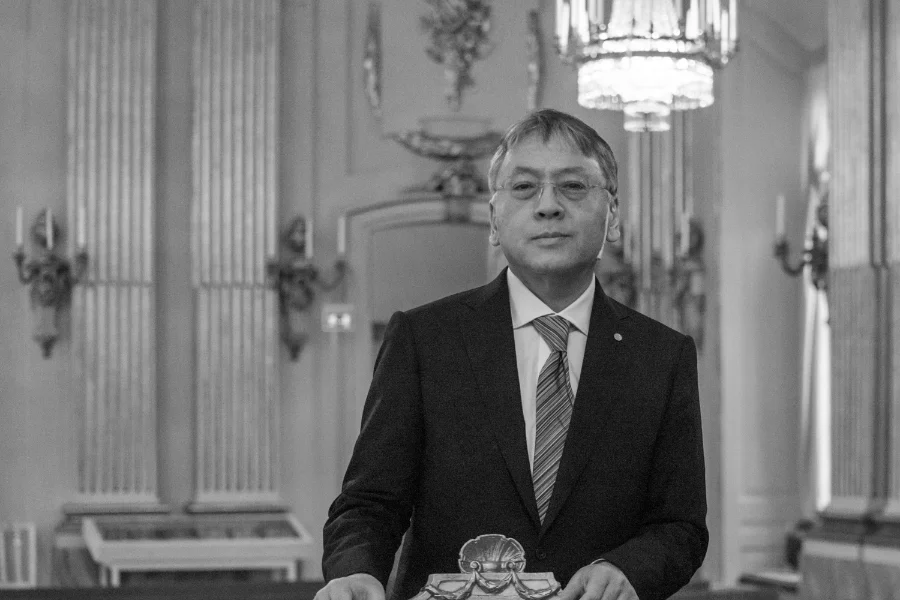
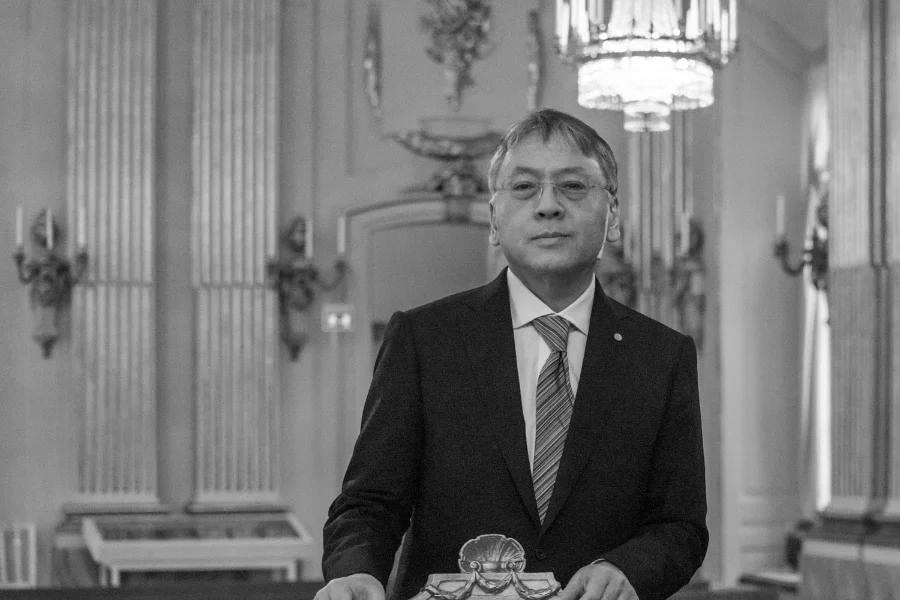
Kazuo Ishiguro in 2017. Photograph by Frankie Fouganthin, courtesy of Wikimedia Commons.
The Origin of the Butler
The butler wasn't a sober research project. In a 2008 Art of Fiction interview, Ishiguro recalls that his wife joked about a journalist coming to interview him about his first novel. Wouldn't it be funny, she suggested, if he answered serious questions while pretending to be her butler? The pair found it amusing. For Ishiguro, it became something more: "From then on I became obsessed with the butler as a metaphor." That's the real key to his work. A servant who performs an identity so completely that nothing personal leaks through is a perfect model for a narrator who can't, or won't, see past his own role.
The Unconsoled and the Refusal to Explain
If The Remains of the Day is restraint, The Unconsoled is restraint pushed until it becomes a fever. The novel runs to roughly five hundred pages and follows Ryder, a pianist who arrives in a quasi-mystical town for a concert that will define his career. He never gets to rehearse. Instead, he mediates feuds between people he barely knows, loses his way every time he leaves the hotel, and chases an appointment schedule that keeps shifting under him. Many critics savaged it. I think they misread the book's intent.
Ishiguro has a direct answer to the charge of obscurity. "It's never my intention to be willfully obscure," he told Susannah Hunnewell. "The novel was as clear as I could make it." Read that way, the dream logic isn't a dodge. It's an attempt to render how anxiety actually feels: obligations multiply, logic stops working, and the person at the center can't find the exit.
A Writer Who Disappears Into His Characters
Here's the thing about Ishiguro's range. Many novelists slip themselves into their protagonists, producing a character who is a diluted version of the author. Ishiguro does the opposite. His inner life is hard to locate in the books, and that absence seems deliberate. It's no surprise that his own biography reads like several careers stacked on each other. He failed to become a musician, hitchhiked up the Pacific Coast Highway, and train-hopped from Washington to Montana on a dollar a day. He packaged baby food. He was also a grouse beater for the Queen Mother, marching across the moors at Balmoral Castle and flushing birds out of the heather so they could be shot.
That restless life shows up in the fiction's settings, which shift across genre and time. Klara and the Sun unfolds in an undefined near future. The Buried Giant moves through a post-Arthurian Britain. The geography changes, but the central fiction stays the same: the belief that people control their own fates. Ishiguro's characters keep reaching for something that was never quite available to them.
Missed by Miles
Ishiguro's sharpest comment on this comes when Hunnewell observes that many of his protagonists miss their chance at love by seconds. "I don't know if they miss it by seconds," he replied. "In a way they've missed it by miles." That line is a fair summary of his method. The tragedy isn't a single bad decision. It's a lifetime of deference, politeness, and self-erasure, which only looks small from the outside.
For readers and critics still arguing over whether his later, stranger books work, that's the useful frame. Ishiguro isn't hiding a self behind his narrators. He's showing what happens when a person has been trained, or has trained himself, never to look too closely.
Discussion
Sign in to join the discussion.