After breaking every wine glass she's owned, a writer finds Gabriel-Glas StandArt stems that look elegant and survive daily use.

My kitchen is the most organized it's ever been. Years of shared apartments meant a mismatched drawer of dishware, takeout containers that had cracked and stained, and a pantry in permanent low-grade chaos. Moving in with my boyfriend gave me a clean slate, and I used it. Food storage containers now sit in one cabinet, each with its matching lid. Spices live in deli containers labeled with color-coded kitchen tape. My chipped water glasses were replaced with a matching set. A drawer holds the linens, taper candles, and flatware I pull out for guests. It all feels very adult. If you've ever lived with roommates, you know how a kitchen fills up with leftovers from other people's lives. Replacing those pieces one at a time is oddly satisfying, and it's less about the objects than about finally deciding what you actually want to use.
The holdout was the wine glasses. I own plenty of coupes and rocks glasses, but I haven't had a matching set of wine glasses since college. When I moved, I had exactly two left. The problem isn't that I stopped trying. I've tested glassware for Bon Appétit and brought home stem after stem, hoping each one would be the keeper. I've broken every single one. At this point it's a running joke among my friends, and not a flattering one. Glassware is a strange category for this. Thin stems and paper-thin rims look lovely on a shelf, but they're built to be fragile, so breakage is less a risk than a timeline.
Elegant and unbreakable, apparently a tall order
My standard isn't complicated, but it's hard to meet. I want a thin stem, a thin rim, and a silhouette that looks good on the table. I also need the glass to survive me. Style and durability usually trade off against each other, and for a long time I assumed that was simply the deal. I'd resigned myself to stemless tumblers, which work fine but never quite feel like an occasion. That's a reasonable bargain for most people, but it's a poor one for anyone who hosts. Fragile stemware gets used less, so it sits in a cabinet looking nice and never becomes the default.
Then I found the Gabriel-Glas StandArt All Purpose Wine Glass, and it broke the pattern. I approached it with the same skepticism I bring to any glass marketed as sturdy. The bowl has a sleek, slightly conical shape that works for reds, whites, and rosés alike. A subtle curve between the bowl and the rim gives it some personality without tipping into fussy. The stem is slim enough to feel elegant, yet it doesn't make me nervous every time I pick it up. The laser-cut rim is a pleasure to drink from, which sounds like a small detail until you've spent years sipping from clumsy edges.
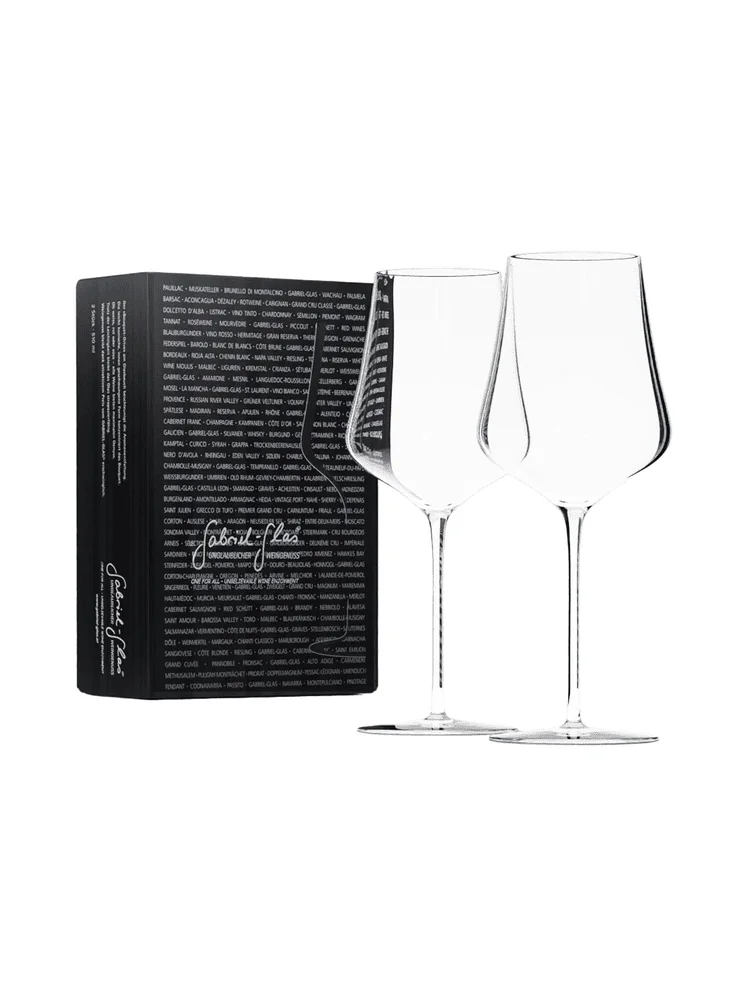
Gabriel-Glas StandArt Crystal Wine Glass. Set of 2 is listed at $68 on Amazon, and a set of six is $197. That works out to roughly $34 a glass for the pair and about $33 a glass for the six-pack, so buying the larger set doesn't cost you much extra per glass. If you're replacing a whole cabinet, that's the number worth checking first.
Why the construction matters more than the look
Here's the thing most wine glass shoppers overlook: where a glass breaks is often where it was put together. The StandArt glasses are machine-blown from a single piece of molten crystal. There's no stem fused to a bowl, so there are no joins, and those joins are exactly where weakness tends to hide in multi-part designs. This is a category-wide pattern, not a quirk of one brand. One piece means fewer places to fail. Single-piece construction isn't magic, though. It just removes one of the most common weak points.
The same manufacturing approach keeps the price down. That matters more than it sounds for someone like me. If a glass does slip off the counter, replacing it shouldn't feel like a financial event. I'd rather own a glass I'm not precious about than one I'm terrified to use, and the economics here let me take that approach. Honestly, the price is more significant than it looks. Cheap enough to replace is different from cheap enough to ignore, and the difference changes how you handle the glass every day.
What the price really buys you
Most glassware guides focus on look and feel, and they're right to. But durability is the hidden variable that decides whether a nice glass ends up in regular rotation. If you're working through the same problem, stop buying for the best-case scenario. Assume something will break and ask whether you'd still reach for the glass afterward. That question tends to sort out the keepers faster than any spec sheet.
And yet, the appeal here isn't only about being careless-proof. A glass that feels good to hold makes you want to pour a second glass, sit a little longer, and actually use the good stuff on an ordinary Tuesday. That's the occasion feeling I'd given up on, and it's the part that's hard to measure. What this means for you depends on whether you host often, whether you're clumsy, and whether you'd rather spend your money on a few fragile pieces or a set you can stop worrying about.
Where this leaves my streak
So where do things stand? All six of my StandArt glasses are intact. That's the real test, and they've passed it so far. They're about to face my new apartment's first stretch of holiday hosting and cozy winter evenings, which is exactly the kind of season that used to end with a dustpan. Bring on the winter reds and the festive bottles of bubbly. I'm curious whether the streak holds.
I won't pretend a few good weeks prove anything. Breakage tends to show up in the moments you least expect, like a crowded table, a rushed rinse, or a wobbly tray. Still, after years of watching my own wine glasses disappear one at a time, I'll take a clean record for now. If it holds through the winter, I'll have a set I actually trust, and that's a more useful outcome than any product rating.
Discussion
Sign in to join the discussion.