Pumpkin overnight oats take about 10 minutes to prepare, offering a filling breakfast before a busy Thanksgiving begins.

Thanksgiving morning rarely needs another task, but skipping food can make a crowded day harder. Between roasting turkey, setting the table, collecting wine, and rolling out pie dough, breakfast often disappears—not because nobody’s hungry, but because the day’s priorities crowd it out. Maple pumpkin overnight oats solve that problem with roughly 10 minutes of preparation the night before. That’s a modest investment for a morning when even finding a clean spoon can become one more thing to manage.
Breakfast Doesn't Need a Myth Behind It
Breakfast isn't automatically the most important meal of the day. Humans managed to thrive long before advertisers turned morning eating into a daily obligation, and the familiar slogan is less a finding of nutritional science than a product of marketing history. That distinction matters: food advice can sound universal even when it’s shaped by commercial interests and cultural habits.
During the 19th and 20th centuries, cereal companies used religious language and appeals to maternal responsibility to sell the first meal of the day. Public relations executives working for a pork producer also persuaded doctors to recommend bacon and eggs as a sustaining breakfast for working families. Those campaigns helped give breakfast a moral and medical weight that still hangs around the meal.
That history doesn't make breakfast irrelevant. It does make the better question more practical: why are you skipping it? On a holiday, the answer is usually time, appetite, or the hope of saving room for dinner. None of those has to be settled by a slogan. A small, prepared-ahead meal gives you another option: eat when it suits you, without adding a morning cooking project.
A Small Meal With a Useful Payoff
Even when hunger hasn't arrived, eating in the morning can help steady energy. Research has linked skipping breakfast with lower intake of nutrients such as fiber, potassium, iron, and calcium, which often come from fruit, whole grains, and dairy. That association doesn't mean one breakfast guarantees a particular outcome, and it doesn't make the meal mandatory for everyone. It does suggest that a breakfast built from substantial ingredients can contribute something useful to the day.
Starting the day with nothing can also leave you dealing with an energy slump, mental fog, and irritability while the kitchen fills with dishes and relatives. The timing is inconvenient: Thanksgiving asks people to make decisions, coordinate tasks, and keep track of food for hours. A bowl of oats won't solve the logistics, but it can take hunger off the list of problems you're trying to manage.
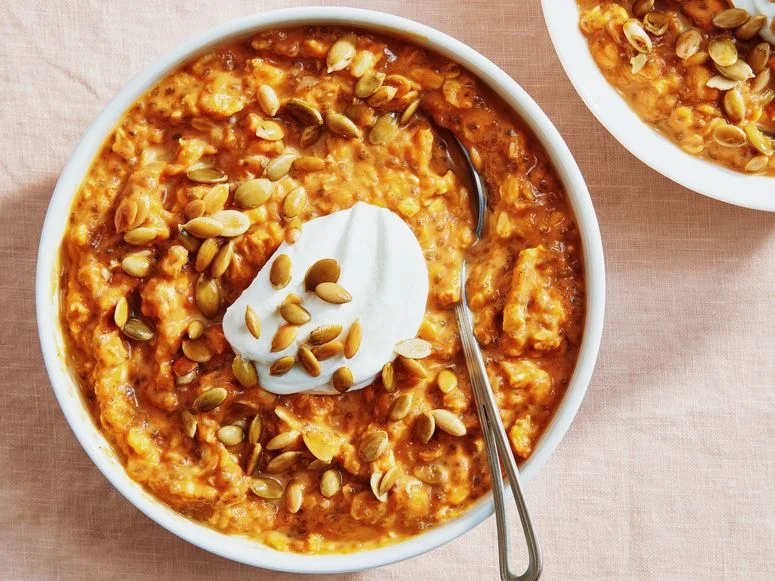
These oats fit the morning before a major Thanksgiving meal because they move the work to the previous evening. Open a can of pumpkin purée, then stir it with rolled oats, maple syrup, milk, and chia seeds. Vanilla and cinnamon add warmth, while the chia seeds help the mixture thicken without becoming gluey. The method asks for basic mixing rather than careful cooking, which is precisely the point when the oven and stovetop already have jobs waiting.
The recipe is part overnight oats, part chia pudding. After several hours in the refrigerator, the mixture becomes lightly sweet and mousse-like. Pumpkin purée brings a useful destination to leftovers from holiday baking, while oats and chia seeds give the bowl enough substance to carry you through turkey roasting and potato mashing. The texture also changes the experience: this isn't simply dry cereal softened with milk, but a chilled, spoonable meal with pumpkin and spice running through it.
This is more significant than it looks. The recipe takes a familiar holiday ingredient and gives it a job before the main event, while the make-ahead format removes several small decisions from a busy morning. If you're working in this space—cooking for a crowd, traveling to a gathering, or trying to feed yourself before a long day—reliable and low-effort can matter more than novelty.
Prepare It Before the Rush
Mix the ingredients the night before, refrigerate them, and serve the oats cold the next morning. The approach works on ordinary weekdays, too, especially when a full cooked breakfast would compete with work or family obligations. Preparing the mixture ahead also means breakfast doesn't depend on getting the kitchen to yourself or finding time to cook while everyone else is getting ready.
There’s a practical trade-off: the oats need time in the refrigerator, so the plan only works if you remember them the evening before. But that’s a small piece of scheduling, and the preparation itself is brief. Make the batch when you’re already putting away ingredients or cleaning up after dinner, then let the refrigerator do the waiting.
What a Make-Ahead Breakfast Changes
The wider value here is less about pumpkin than planning. Holiday cooking tends to reward advance work: ingredients get measured, dishes get staged, and tasks are moved away from the busiest hours. Breakfast can follow the same logic. A prepared bowl won't change the menu or lighten the work of hosting, but it can give you one fewer meal to improvise.
And yet, the recipe shouldn't be treated as a rule. If you aren't hungry early, you don't need to eat just to satisfy an old advertising message. If you are hungry, or know that a long stretch of cooking leaves you distracted, having something ready may be useful. The choice is yours; the advantage is having a choice that doesn't require turning on the stove.
The useful takeaway is simple: a holiday breakfast can be quick, make good use of pantry ingredients, and leave you better prepared for the work ahead. In this case, a little preparation the night before buys a quieter start to the day. Not a feast. Just one less moving part. More healthy breakfast recipes can take the same approach.
Discussion
Sign in to join the discussion.