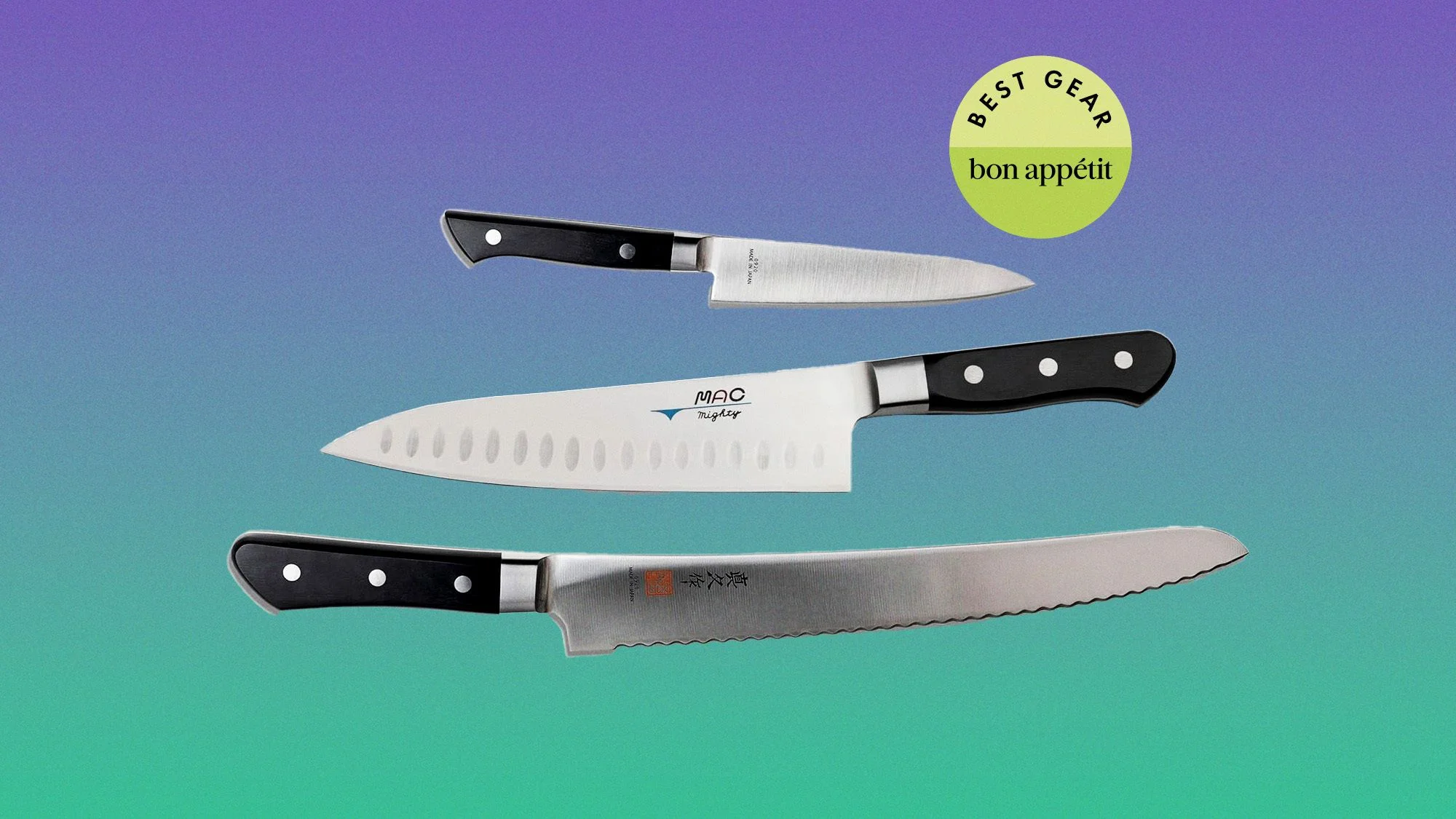
A chef’s knife, bread knife, and paring knife cover most home cooking. These tested sets offer quality and value, from compact picks to larger collections.
Skip the 18-piece block
You don't need an 18-piece knife block with a blade for every task. Open one up in a real kitchen and you'll often find several knives still wearing their factory edge, because nobody ever used them. Still, the sets themselves have a real pitch. Buying every knife separately can add a 15 to 20 percent markup for most home cooks, and that's the gap sets are built to close.What actually belongs in a set
After testing dozens of knives and talking with our Test Kitchen editors and professional chefs, the answer converges on three pieces: a chef's knife, a bread knife, and a paring knife. That's the core. Everything beyond it is optional. Once you're cooking more often, a nakiri, a petty knife, or a versatile cleaver can earn a spot. Our advice is to add them one at a time, based on how you actually cook and how much you're willing to spend on a knife. Don't buy them because a set includes them. Here's the thing: many of the best knife makers produce strong versions of several knife types, so a good set doesn't have to sacrifice quality for the extra pieces. The sets below were chosen for performance and value together. Nearly every knife in them was tested individually, so you can expect to slice, saw, and core with any of them.How the picks break down
- **The best knife set overall:** Mac Professional Series 3-Piece Knife Set - **The best budget knife set:** Mercer Culinary Renaissance 5-Piece Magnetic Board Knife Set - **A Western-style favorite:** Wüsthof Classic 3-Piece Starter Set - **The best large knife set:** Global 11-Piece Knife Set If you want more pieces, the list runs to a couple of larger options that come with a knife block and steak knives. Editors also spent extended time living with the top picks, and their long-term notes are now folded into the reviews. That matters more than a first-week impression, especially for a knife you'll sharpen for years.Best knife set overall: Mac Professional Series 3-Piece Knife Set
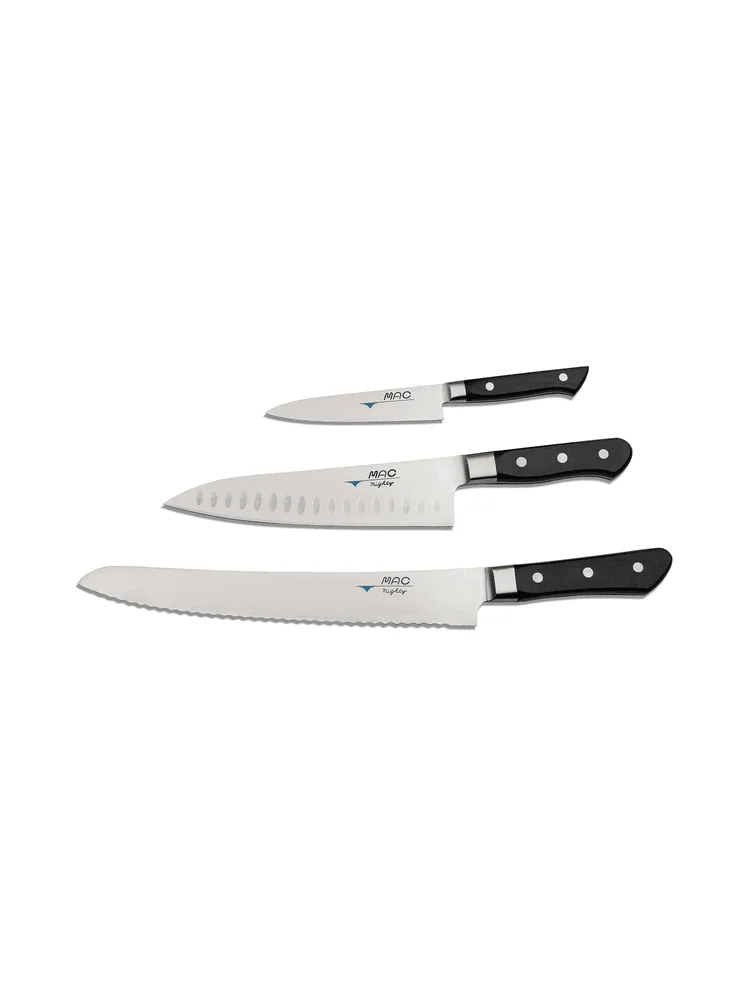 This is the one I'd point most people toward, though it comes at a price. At $435, it's not a casual purchase. Testers praised how sharp it is, how well balanced it feels in the hand, and its hybrid shape, which works for a range of cutting tasks. The drawback is the steel, which one tester flagged as a little brittle, so it's worth handling with some care. If you're weighing it against the budget picks, that tradeoff is the question to settle first.Mac's knives keep coming out on top in our testing, and it's not just the blades. Few lines pair this much sharpness with a comfortable feel and a middle-of-the-road price. This three-piece set bundles the two Mac knives we rate highest in their categories, a chef's knife and a petty knife, with a bread knife that's essentially a more refined version of our favorite serrated knife.
The chef's knife that earns the top spot
The Mac Professional Chef's Knife is the anchor of the set, and it's easy to see why. The ergonomic pakkawood handle is comfortable through long sessions, and it could get through a mountain of vegetables without leaving my hand cramped. The blade was one of the sharpest we tested. What makes it interesting is the construction. The knife is forged from [molybdenum high carbon steel](https://www.imoa.info/molybdenum-uses/molybdenum-grade-stainless-steels/metallurgy-of-molybdenum-in-stainless-steel.php), and that choice splits the difference between two traditions. Japanese blades use brittle steel that can be honed to a fine edge, while Western knives use softer, more forgiving steel that holds up to abuse. Mac lands in between. The shape follows the same logic: a rounded belly like a Western chef's knife, with a straighter cutting edge closer to a Japanese one.The petty and bread knives
If you're already fond of Mac's Professional Series, the petty knife will feel familiar. It's razor-sharp, and its shape falls somewhere between a utility knife and a paring knife, which makes it a useful tool for jobs that don't need a full chef's blade. The bread knife is the most surprising piece of the set. It comes from the same Professional Series, but it's a step up from the [Superior Series bread knife](https://www.amazon.com/Mac-Knife-Superior-Bread-2-Inch/dp/B000MYZSYM) that won our bread knife test. It shares that model's scalloped blade, but it adds a metal bolster that creates a cleaner transition between blade and handle. That small change makes a noticeable difference in balance when you're slicing.What a year of daily use showed
I used these knives for more than a year, and the chef's knife for five, and they held up. The paring knife runs long, so it's better for hard cheeses than for peeling or coring. I'd reach for a Y-peeler and an apple corer for those jobs anyway. The extra length does make it easier to sharpen, though. The bread knife was the standout. Its serrations and curved blade give you excellent leverage, and because the teeth are wavy rather than pointed, I never noticed it losing its edge. The weight helps too. It's heavy enough to push through a loaf without tearing the crust. The chef's knife is where the trade-off shows up. It's the old standby that nearly every reviewer and Test Kitchen editor who has used it still recommends. Its balance, weight, and shape make it versatile, and the steel takes a sharpening well. But after a couple of years, my Mac chipped. I resharpened it and saved the blade, yet I wasn't the only one to see this happen. The Mac we kept in-house for long-term testing also chipped after a few years. Reviewer Jesse Raub has made the same point across several of his knife reviews: Japanese-style knives use harder steel, so they resist dulling but are more prone to chipping. That's the core bargain. It's not clear from our testing how often this happens under ordinary home use versus heavier use, and I'd be careful about treating a few chipped blades as a pattern. Still, if you're choosing a knife, you should know which way the trade goes. For me, it doesn't change my recommendation.Another great knife set: Shun Classic Damascus 3-Piece Knife Set
If you want the high-end look of Damascus steel and prefer a chef's knife with a rounder belly for rocking through herbs, the [Shun Classic Damascus set](https://shop.com/products/7547816411390/shun-classic-3-piece-knife-set?variantId=42406870679806) is worth a look. It's priced at $370. 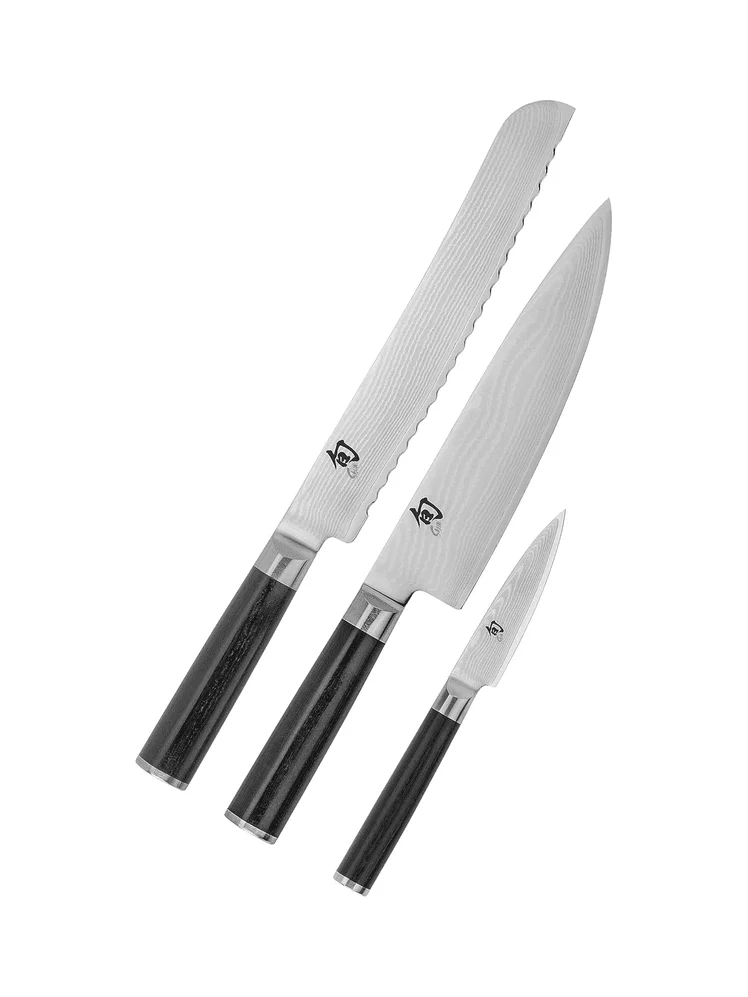 Shun's knives perform consistently well in our testing, and each piece in this set earned a top pick in its category. The set includes an 8-inch chef's knife, a 9-inch bread knife, and a 3.5-inch paring knife, all built from VG-Max high carbon steel with a full tang. Testers praised the sharpness, the patterned steel, and the balance. The main complaint is that the bread knife is a little short. Buying the three as a set also saves a modest amount compared with purchasing them individually.Shun Classic: sharpness that holds up in daily use
Shun’s VG-MAX steel is the foundation of the Classic line. The high-carbon core includes chromium and molybdenum to support corrosion resistance and edge sharpness, and in our testing the knives sliced cleanly through a range of ingredients and stayed sharp over time. [Shun’s steel overview](https://shun.kaiusa.com/blade-steels) explains the materials behind that performance.
The rounded pakkawood handles are comfortable, with an even thickness that lets you settle into the grip that suits your hand. Shun’s blades also have a hybrid profile: more Western in shape than many Japanese knives, but with the fine edge of a gyuto. That blend makes them versatile. The bread knife is shorter than we’d prefer, yet it was the sharpest we tested and cut through everything easily.
After a year, these are still my go-to knives. The chef’s knife feels especially good in my small hands, and the smooth junction between blade and handle gives me a natural place to pinch-grip. Its profile handles both rocking cuts and tough ingredients. The paring knife is precise enough to hull strawberries, with enough heft for a thick wedge of Manchego. At nine inches, the bread knife gets through most sourdough miches; wide loaves can call for a longer blade.
Shun’s appeal isn’t just an impressive edge out of the box. The comfortable handles and adaptable blade shapes make that sharpness useful in everyday cooking. The bread knife’s length is a real limitation for some loaves, but it hasn’t outweighed the rest of the set’s strengths in a year of regular use.
—Olivia Tarantino, senior reviews editor
Best budget knife set: Mercer Culinary Renaissance 5-Piece Magnetic Board Set
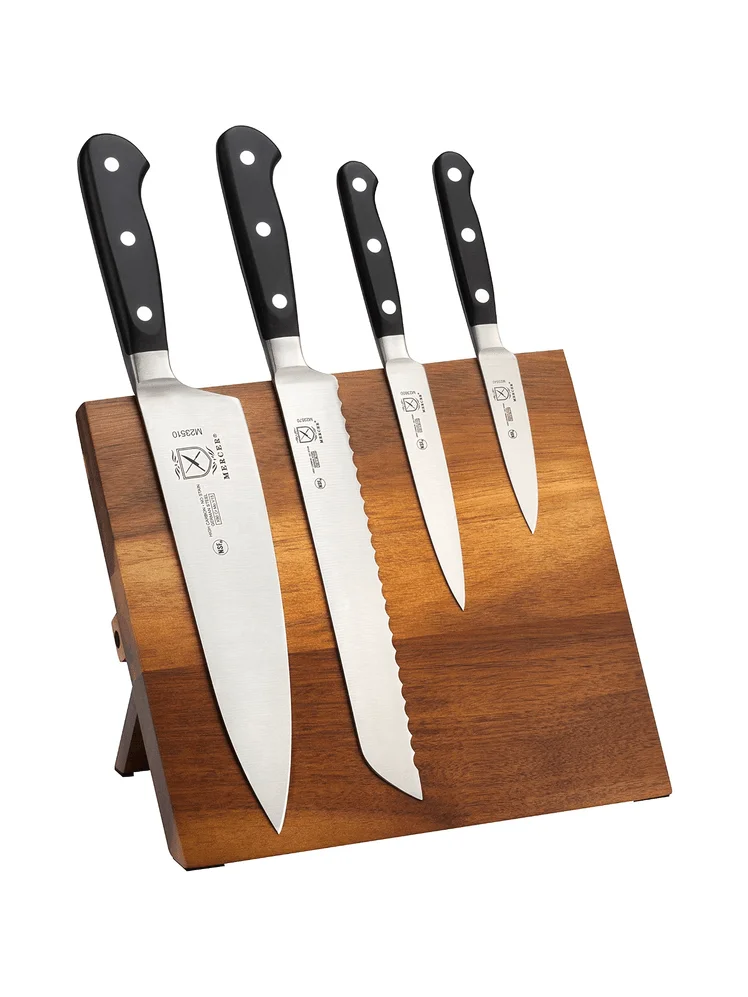
The Mercer Culinary Renaissance 5-Piece Knife Set With Magnetic Board is listed for $181 at Amazon.
Discussion
Sign in to join the discussion.