A Berkeley writer traces the mystic G. I. Gurdjieff’s influence through Joy Williams’s elusive short story and an unexpected first meeting.
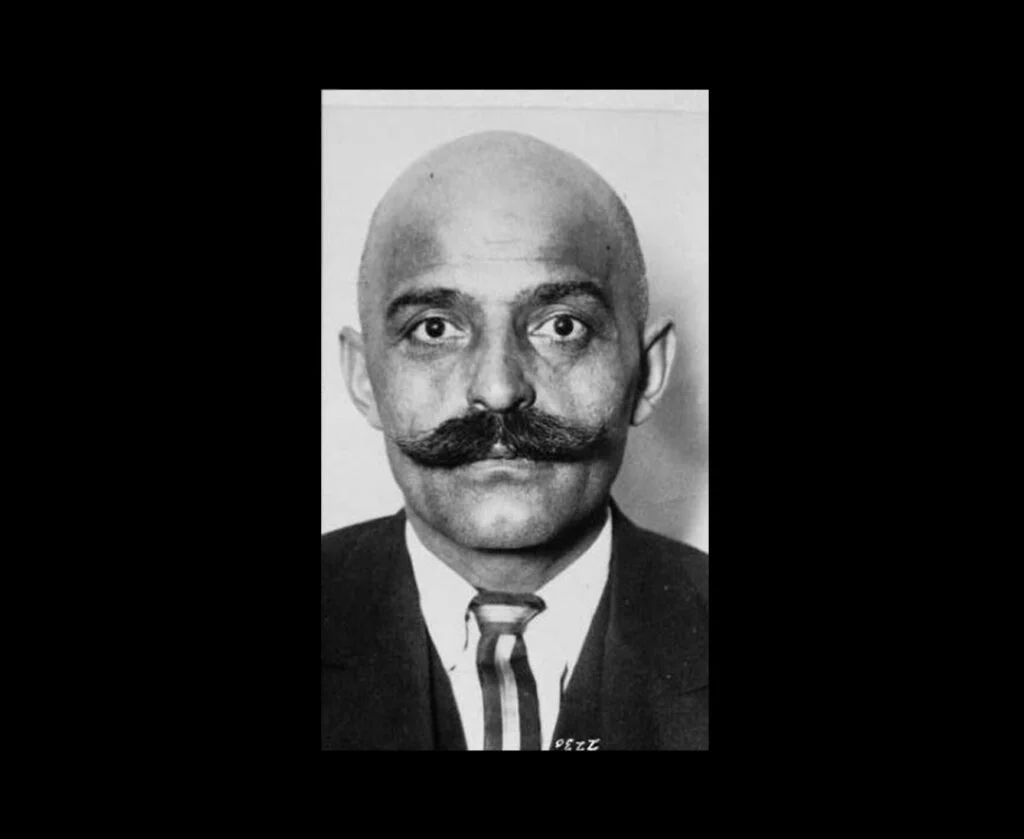
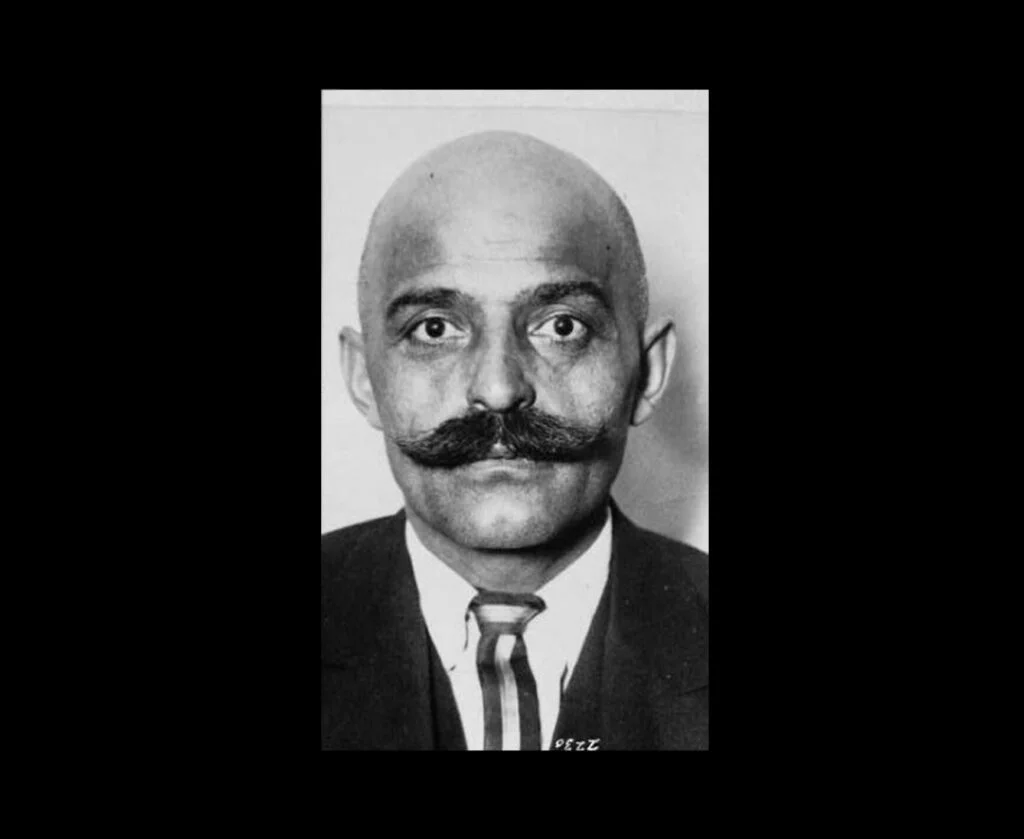
Janet Flanner-Solita Solano papers, Library of Congress. Public domain, via Wikimedia Commons.

The oddest thing about my first encounter with Gurdjieff was how quickly I decided it must mean something. One week, flyers appeared on East Bay telephone poles, their tear-off tabs arranged like a job notice or a yard-sale ad. The headline promised “AN INTRODUCTORY DISCUSSION: G. I. GURDJIEFF.” The copy invoked spiritual practice and cosmic scale, hinting at some grand union of spirit and matter, person and whole. In practical terms, it was an invitation to public meetings in Berkeley. I sent an email saying I was interested. That was mistake number two.
I had to stand in front of one of the flyers for several minutes before I remembered why the name felt familiar. George Ivanovich Gurdjieff, the Russian-born mystic, teacher, sacred choreographer and sometime composer of piano music, had already found his way into a narrow, easily overlooked corner of Joy Williams’s short fiction. The connection had sent me looking.
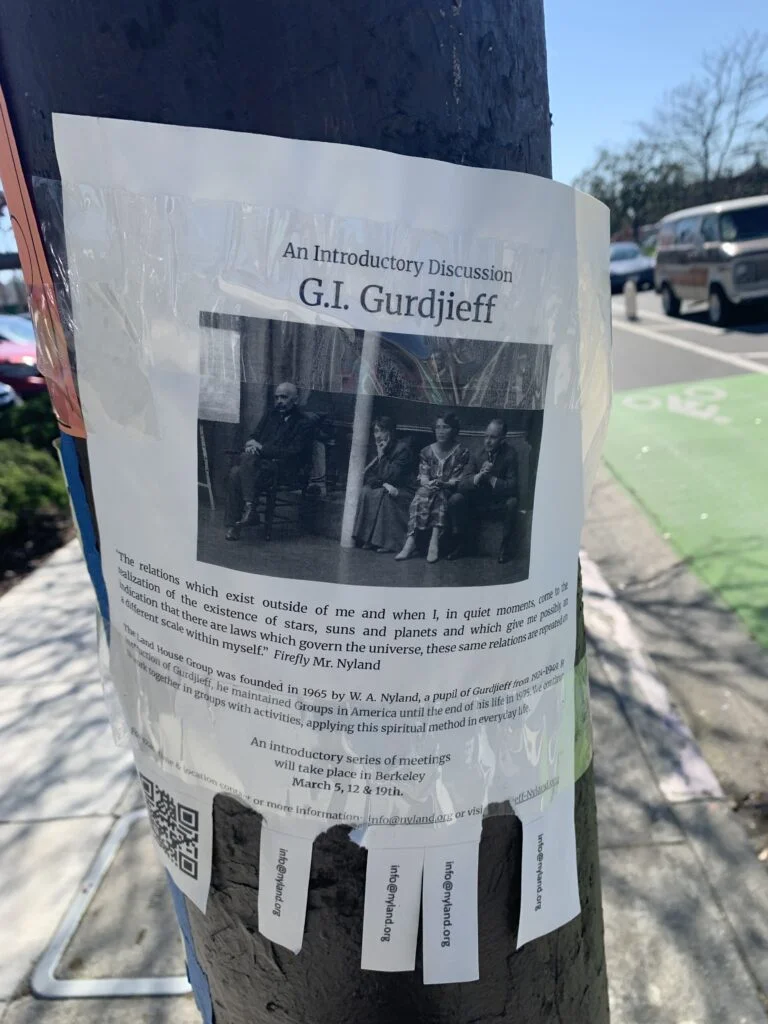
Photograph by Drew Dickerson.
A ghost in Joy Williams’s fiction
Williams’s “Gurdjieff in the Sunshine State” appeared in her 1990 collection Escapes. Yet when The Visiting Privilege, her nearly complete collected stories, came out 25 years later, this one was missing. I still can’t explain the omission—or claim to understand the story, where G. astral-projects to Florida, watches a roller rink, drinks a Tab and briefly speaks with a figure who may be the ghost of Katherine Mansfield. Left out of the collected work, the story seems to have acquired a kind of secrecy of its own.
Williams once hinted that it might have become part of a larger project. In a 2011 note to her editor, the late Gary Fisketjon, she wrote: “There is a Gurdjieff story in Escapes. I was going to write a whole mess of these stories on Gurdjieff but haven’t, you’re probably happy to know.”
The historical Gurdjieff spent much of the late 19th and early 20th centuries traveling between the Mediterranean and southwest Asia. Along the way, he took in teachings that helped shape his blend of Sufi, Hindu, Zen and Christian ideas. His system of thought and practice, later known as the Fourth Way, passed between generations and made him a major influence on what we now call the New Age Movement.
I learned some of this at my first meeting, held in a side room at a Unitarian Universalist fellowship hall. The setting could have come from Williams’s “The Country”: there, people from different denominations gather each week in one of an Episcopal church’s “many, many rooms” to ask, “Why Are We Here?”
I sat in a circle beneath a framed black-and-white portrait someone had hung before the meeting. It was my first time seeing Gurdjieff’s face. His eyes looked enormous. The introductions that followed were cryptic, and most of the group seemed fluent in currents of thought adjacent to Gurdjieff. They passed around names and references as if we were all supposed to know the code.
“I was brought here out of interest in the work of Maurice Nicoll.”
“Yes, well. Nicoll certainly had a lot to say, didn’t he? Maybe he ran out of things to say by the time of his fifth book. You should read Ouspensky.”
“I’m wary of Ouspensky. Remember what Gurdjieff told him: if you understood half of what you know, you’d be my teacher.”
Newcomers were asked why they’d come. I admitted that I was following a literary clue: Williams had made Gurdjieff a marginal presence in her fiction, and I wanted to know why. I also said I hoped to feel closer to God. That part was true, too.
The answers around the circle varied. One woman described a near-death experience a few months earlier that had left her seeking greater spiritual attunement. Another, silenced as a child, said she now wanted to find her voice. A third person recounted a recent LSD experience, then showed us a decorative knife he said had been forged from genuine meteorite metal. It was at least six inches long.
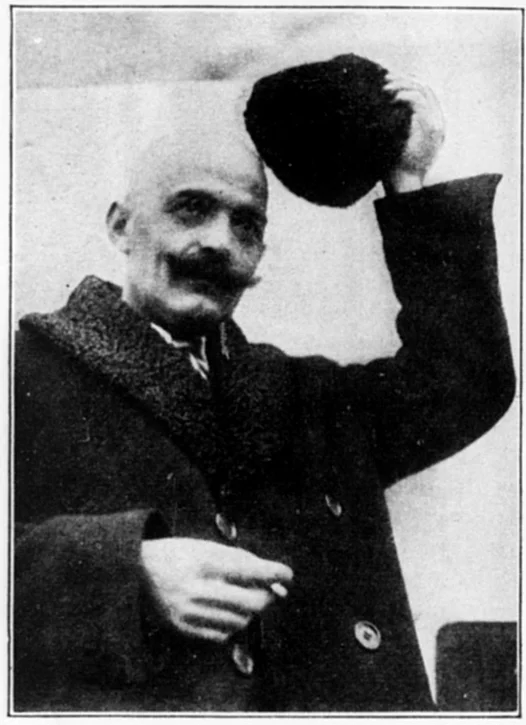
Georges Gurdjieff, 1930. Time, Public domain, via Wikimedia Commons.

In that room, experience meant the sudden spiritual insight that changes a person. Vibration came up often, as did self-observation, self-knowledge and self-remembering. When a first-time visitor happened on the word wish, someone gasped. Apparently, the wish mattered. The lights were low and the patchouli strong. I was mostly bored, though every so often the boredom gave way to a strange sense that anything might happen.
Not everyone was satisfied. One attendee, who said he had spent years in human-development workshops at the Esalen Institute, pointed out that we’d heard Gurdjieff’s name often enough. What, specifically, did he teach? What did he promise? I shared the disappointment. We’d been told there were answers, but the meeting had become a sequence of personal stories, with little explanation of the system itself.
“You’re right to ask,” one man said. “Gurdjieff works by allegory. He says of his writing in All and Everything: ‘I bury the bone so deep that the dogs have to scratch for it.’”
From two stories to a whole series
Williams’s other Gurdjieff story, “George and Susan,” appeared in Tin House in 2014 and later in The Pelican Child. She identifies him only as G., perhaps echoing P. D. Ouspensky’s memoir In Search of the Miraculous, which refers to the teacher by that initial. In the story, G. haunts Susan Sontag’s childhood home in Tucson, where Williams lives, and may witness a car crash.
I began to imagine a series: G. crossing state lines, one story for every state. Fifty stories somehow seemed more plausible than two. In “George and Susan,” Williams writes: “It is only through effort, through will, through work work work that two becomes extraordinary.”
That idea fits what I’ve always valued in Williams: her stories treat ordinary life as a place where hidden meanings might surface. They’re full of prophecy, obscure messages, theological argument and sudden revelations that connect the everyday to something larger. On KCRW’s Bookworm in 1991, she called the short story “the closest thing we have to a moral form. It’s a method in which to really dwell upon—reflect upon—the things that matter.”
Maybe that’s what made Gurdjieff useful to her as a character. He believed that daily habit buries what matters, and that pain or effort can bring it back into view.
At the group’s second meeting, I remember hearing the words shock and work. “Shock” meant the jolt of experience that might wake someone from an unexamined life and toward consciousness. Stories about Gurdjieff’s methods often describe him creating such jolts deliberately: followers were given contradictory instructions, made to dig ditches until they were exhausted, or subjected to sudden, furious outbursts.
One prominent member, an electrical engineer, proposed a small task instead. “Every morning for the next week, I think we should check in with ourselves and exercise gratitude for this moment as well as the day ahead. Would anyone like to take me up on this?”
“I’ll do it.”
“Me too.”
“I can’t wait to.”
Afterward, someone came over to tell me they’d read “George and Susan” and found it “a trip.”
For several weeks, I kept attending. I listened, explained my reasons for being there and tried to stay open. What I accumulated was a string of personal and literary coincidences that I couldn’t quite make meaningful. In graduate school, two faculty mentors, for different reasons, had each pointed me toward the same sentence in Edward Said’s On Late Style.
Following that lead brought me to Williams’s “Hawk,” a personal essay about listening to piano music for long stretches during an unexplained illness. I was surprised, though perhaps I shouldn’t have been, to find her writing: “I listened to Thomas de Hartmann play the music of Gurdjieff.” Williams confirmed the connection in an interview with the magazine last year, calling de Hartmann and Gurdjieff “her old friends.”
I decided to do something literary scholars are trained not to do: ask the writer what she meant. I also had a postcard I wanted to send Williams, featuring Jane Bowles. Williams’s fiction is full of postcards. In “Train,” one character says, “In this world there is a postcard of everything. That’s the kind of world this is.” Choosing one, then, meant choosing among everything. I hoped a picture of Bowles looking assertive beneath her untidy mop of hair would please Williams and me alike.
I couldn’t decide how to ask about Gurdjieff: was there an unpublished center to Williams’s work, with the two existing stories circling it? A postcard is an exposed little thing, sent without an envelope and readable by anyone handling the mail. The question felt too intimate for that open space. As Jacques Derrida puts it in The Post Card, it is “half-private, half-public, neither the one nor the other.”
I mailed it. Soon afterward, I quietly stopped going to the group. I couldn’t shake the thought that Gurdjieff’s distinctive insights had either been deliberately kept from us or didn’t exist. I wasn’t sure which possibility was worse. Either way, the answers I wanted seemed unlikely to arrive. I emailed an excuse about a scheduling conflict. The group had told me that awakening began with recognizing how deeply asleep one was. Maybe I didn’t have the nerve for the jolt.
A fall, then a postcard
The evening I missed my first meeting, I woke suddenly on the floor beside my bed. It felt like the instant of falling in a dream, except I had actually fallen. My body’s reflex came too late; what followed was a painful, full-body flinch and an ugly noise. I thought I might have a concussion. In the dark, my fingers found something sticky on my forehead. My partner and I decided we’d have to go to the emergency room early.
Two apparently drunk attendants admitted me. From the next room, I heard a patient screaming as someone reset his shoulder. A nurse asked about my injury, shone a penlight in my eyes and had me track a gloved finger. I’d fallen out of bed and struck the vents of my air purifier, which may have spared me a worse impact. A doctor closed the wound with a glue he described as having an elegant pine scent. Before sunrise, I was discharged with a $250 copay, a cut above my left eye and instructions to keep it clean.
The next morning, the group member I’d contacted at the start of my experiment emailed:
You were missed. Thank you for your email. It is much appreciated. Come next week. The meetings continue. I am in Texas this weekend for a movements intensive. I am very interested in how you are responding to the introductory meetings. Perhaps you tried Robert’s task of taking a moment when your feet hit the floor sitting at the edge of your bed being grateful for life and the day ahead.
I started calling the mark my Gurdjieff scar. Sometimes I called it my Joy Williams scar. I joked that Gurdjieff’s spirit had given me a bump in the night, and occasionally I half-believed it. Mostly, I was embarrassed by how much explanation an injury seemed to demand. Still, I wondered whether the fall had changed me, or humbled me—whether it had made me notice how much of the world lay beyond the boundaries I’d assumed were real.
Then the postcard arrived. On the front was a midcentury illustration of vacationers by a Palm Springs pool. Williams had written:
Thanks for the JB card. I don’t have one! Yes, I wanted to do a G collection but my editor at the time, the infamous Gary Fisketjon thought it was nuts. Still—I think—G at the mule dressage events; G at Walden Pond … You should read MAURICE NICOLL and of course OUSPENSKY. Nice hearing from you,
Joy
That reply made the imagined series real, at least as a possibility: Gurdjieff at mule dressage events, Gurdjieff at Walden Pond. It also gave me a practical reading list. The mysteries hadn’t vanished. But Williams had answered, and the answer had arrived in exactly the sort of exposed, ordinary object her fiction seemed to know how to use.
Drew Dickerson is a writer and graduate student in English at UC Berkeley. His work has appeared in n+1, The Point, The Drift and The Onion. He is working on a novel.
Discussion
Sign in to join the discussion.