Crispy chicken thighs, lemon, and romaine roast together in one pan, then get tossed with a creamy dill and buttermilk dressing.
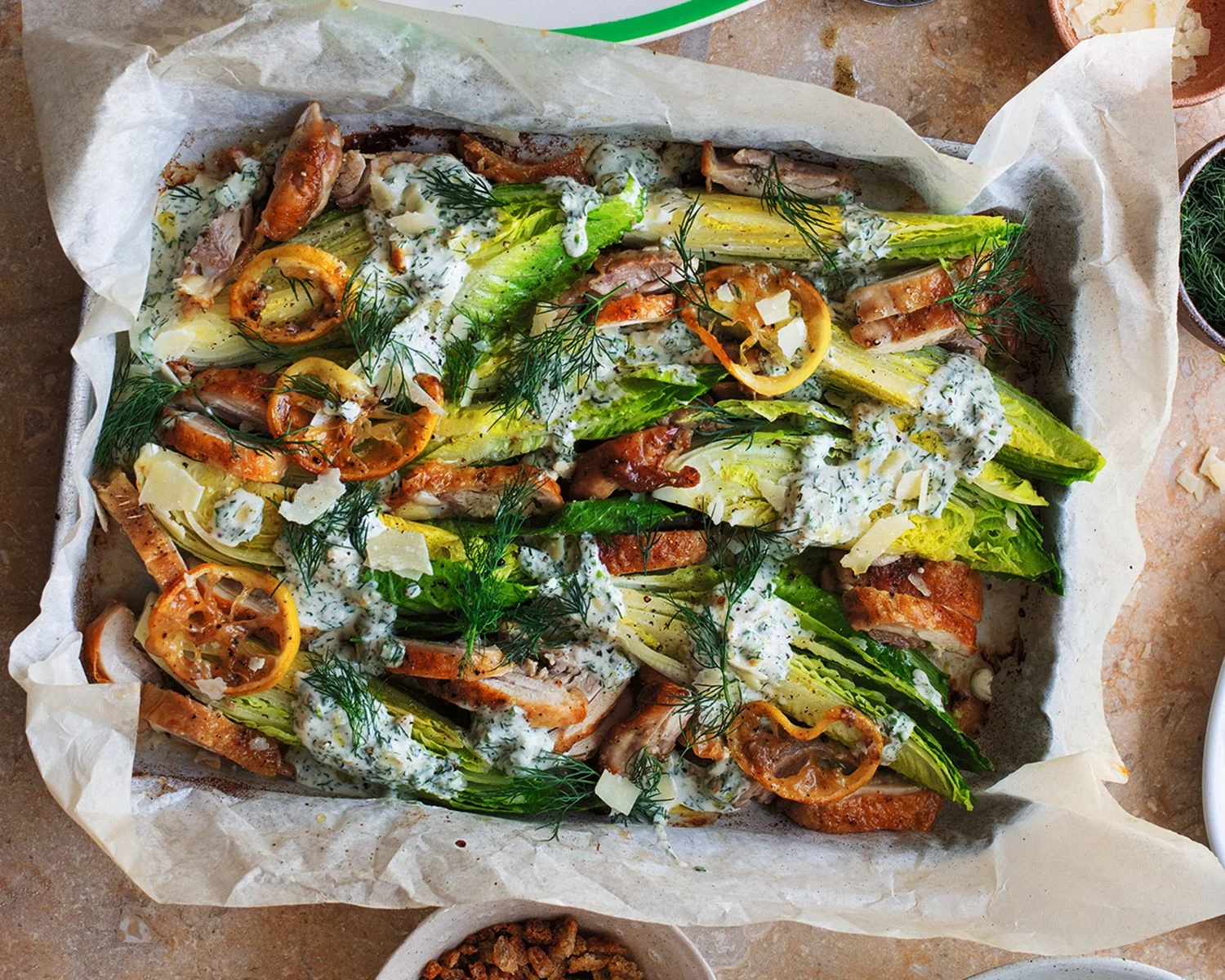
Chicken Caesar, built on the sheet pan
The smart move here is letting the chicken and lettuce share the same pan. Skin-on, boneless thighs roast until crisp alongside thin lemon slices; then romaine picks up the savory drippings and softens at the edges. The result leans into Caesar’s familiar flavors while a dill-and-buttermilk dressing gives it a ranch-like comfort. For anyone feeding kids, that may be the recipe’s most persuasive detail.
That combination also changes the character of the salad. Traditional Caesar depends on a sharp contrast between cool, crunchy leaves and rich dressing; here, the lettuce turns warm and yielding, closer to a roasted vegetable. The chicken’s skin supplies the crisp element, while lemon brings brightness to the fat left on the pan. It’s a deliberate trade, and one that makes the dish feel more like a complete dinner than a salad with protein added on top.
The dressing sets the tone
It takes 50 minutes and serves four. Make the dressing with 1 cup (115 g) mayonnaise, ⅓ cup (80 ml) buttermilk or kefir, 1 teaspoon Dijon mustard, 2 finely chopped green onions, ½ teaspoon each ground onion and ground garlic, ½ ounce (15 g) finely grated Parmesan, and ¾ cup (15 g) chopped dill. Season with 1 teaspoon fine sea salt and a few grinds of black pepper; save extra Parmesan and a few dill sprigs for serving.
This isn’t a conventional Caesar dressing built around anchovy and egg. Mayonnaise provides a reliable creamy base, while buttermilk or kefir adds a mild tang; dill and green onion push the flavor toward ranch. Parmesan keeps a recognizable link to Caesar, though it plays a supporting role alongside the herbs. That’s likely why the dressing can appeal to diners who find a more assertive Caesar too salty or intense.
The quantity matters, too. Half goes onto the warm lettuce and chicken, where it mingles with the pan juices; the rest is added at the end, so the finished dish still tastes freshly dressed. If you're cooking for people with different preferences, that staged approach gives you some control over how rich each serving becomes.
Roast first, then let the pan do more work
Heat the oven to 425°F. Arrange 6 skin-on, boneless chicken thighs (about 1¾ lb./800 g) on a parchment-lined baking sheet. Season with ½ teaspoon salt and pepper, add 1 thinly sliced lemon (about 12 slices), and drizzle with 2 tablespoons extra-virgin olive oil. Roast for 30–35 minutes, until the chicken is crisp and the lemon begins to caramelize.
The high heat is doing two jobs: rendering fat from the skin and concentrating the lemon’s flavor as its surface browns. Thin slices are useful here because they can soften and caramelize in the same time the thighs need to cook. Still, ovens vary, and “crisp” is a visual cue rather than a precise timer. The stated cooking window gives a guide; the texture of the chicken and lemon is the point.
Let the chicken and lemon rest in a shallow bowl for 10 minutes, keeping the pan and its juices. Finely chop half the lemon slices and stir them into the dressing. Slice the chicken into ½-inch (1 cm) pieces and toss it with the remaining lemon. Put 2–3 lengthwise-quartered romaine heads (14 oz./400 g) on the baking sheet, season lightly, and turn them in the juices. Spoon over half the dressing, add the chicken, then finish with the remaining dressing, croutons, extra Parmesan, and dill.
That sequence makes the pan a seasoning tool, not just a cooking surface. The lettuce absorbs some of the rendered chicken fat before the dressing goes on, and the chopped lemon carries its roasted, slightly bitter edge into the sauce. The croutons arrive at the finish, where they can retain some crunch instead of sitting in the pan juices from the start. A little restraint with the first pour of dressing helps preserve those differences in texture.
What the method changes
That’s a practical trade: the lettuce softens instead of staying crisp, and the pan juices do much of the seasoning work. If you want more ideas for cooking dinner this way, see these sheet-pan dinners. For other ways to use chicken thighs, there’s a recipe collection for that, too.
Sheet-pan cooking often promises easier cleanup, but the more meaningful advantage here is how the ingredients share flavor. The method asks you to accept a softer salad in exchange for a warmer, more integrated meal. This is more significant than it looks: the lettuce is treated as part of the roast, and the dressing is split between a finishing sauce and a seasoning layer. And yet, the payoff depends on liking cooked romaine; if you want a crisp Caesar, this recipe won’t scratch that itch.
For a household meal, the familiar chicken-and-Parmesan profile may help the change feel approachable. The dill dressing offers a gentler route into the recipe than a strongly anchovy-forward Caesar, while lemon keeps the richness from dominating. One-pan ease, with a distinct point of view.
Source and cookbook details
The recipe is credited to Ottolenghi SIMPLE TOO, by Yotam Ottolenghi and Verena Lochmuller. The book is published by Ten Speed Press, an imprint of the Crown Publishing Group, a division of Penguin Random House LLC. Text and photographs are copyright © 2026; Jonathan Lovekin took the photographs except where noted, and Verena Lochmuller photographed pages 24, 82, 116, 199, 200, and 268. The book is available from Amazon and Bookshop.
Discussion
Sign in to join the discussion.