AI-generated Reels ads turn aging into a tearful soap opera, selling the fantasy that age can be purged with a serum or a mushroom drink.
All photographs courtesy of Jean Garnett.
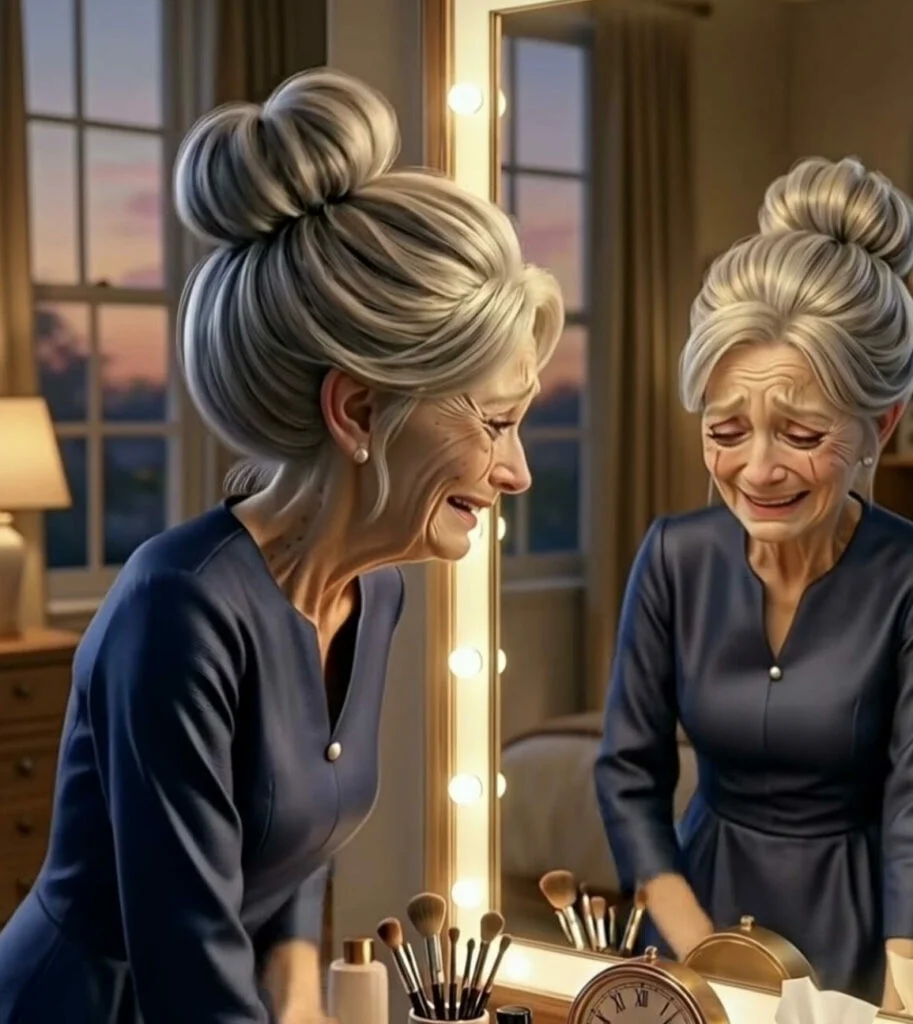
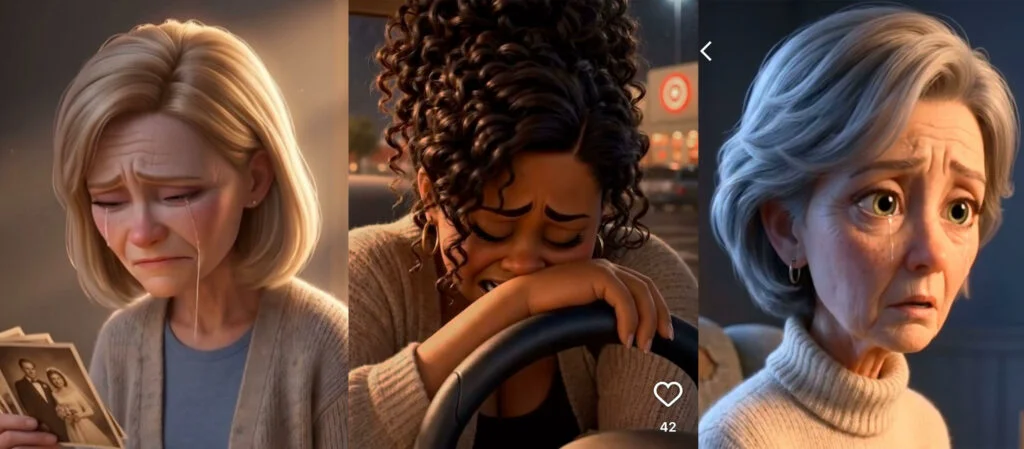
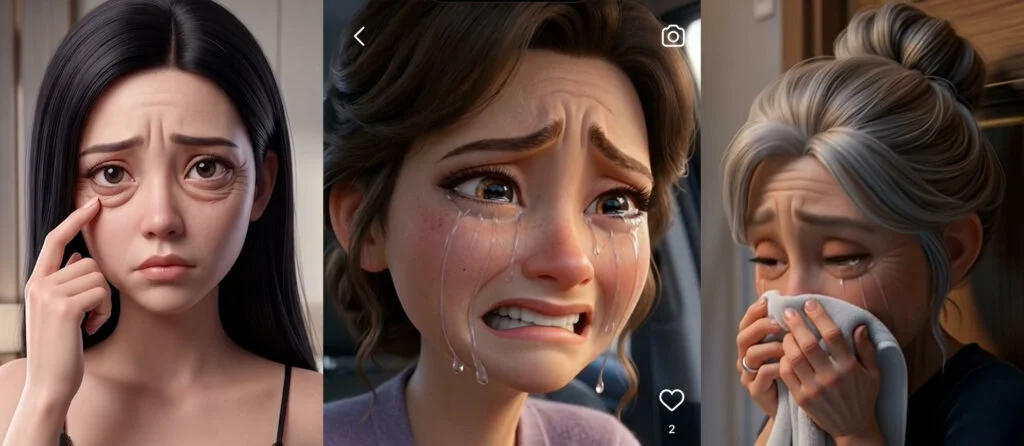
The tears give it away. I stopped scrolling because they're wrong. They pool in wide, frightened eyes and bulge into droplets, but they don't roll down the cheek or soak into the skin. They hang from the lids like snot, transparent and swollen, trailing mucous threads.
The eyes belong to a woman with a big head on a hunched body, drawn in the bright, rounded style of a Pixar short. She cries at her desk. In the next version she cries in the bathroom, at the wheel of her car, at her son's soccer game or her daughter's rehearsal dinner. The cause never changes. She's sad because she's getting older, and she's getting older because she's sad. Her life is one loop of cause and effect, and aging is the whole plot.
The husband who left
Naturally, she's losing her husband. "You used to light up," he tells her in one video. "You just don't look like yourself anymore." In another she overhears him telling a friend she's "let herself go." In a third he has already left for a much younger woman, or he's sleeping with a colleague who hasn't let herself go. The setup changes. The verdict doesn't.
So who steps in? Sometimes it's her sister, just back from a business trip to Seoul. Sometimes it's a friend or coworker who lives in Seoul. Sometimes it's the daughter, who sheds her own tears as she watches her father walk off with his new girlfriend. In that version the daughter, dragged into her mother's humiliation, sets out to save face: her mother's literally, her own figuratively. The rescue comes in the form of a hydrating gel mask, a serum, or a nonoxidizing foundation. The product changes from ad to ad. The fix is always the same.
Purification slop
These spots have started showing up every time I swipe through Instagram Reels. I've come to file them under a broader category I call "Purification Slop": obviously AI-generated marketing that targets a specific fantasy, the idea that whatever ails you, age included, can be pulled out of you and set aside. The ads know that I like seeing something "built up" inside a person finally come out.
Consider the pitch. Stand in a sunbeam in your kitchen, sip a mushroom drink, and watch cute little probiotics tra-la-la through your intestines like a chimney sweep in a Disney musical. You'll glow with inner cleanness. Have you drained your lymphatic fluid with a jade roller lately? Or are you fine hosting putrid waste in your body? The machine may also know that I'm single, and that mirrors have gotten complicated for me. It depends on the light. It depends on my mood.
The fake science and the limited-time offers are the familiar parts of the infomercial format. What's new is the emotional register. These ads feel less like commercials and more like miniature soap operas. I timed one at over ten minutes, which is a long time to spend inside a product pitch. They're maudlin in the best and worst sense. Each one is a songified story, closer in structure to a Taylor Swift or Olivia Rodrigo breakup track than to any ad I remember. It starts with a confessional, conversational grief and builds to a pleading, triumphant chorus. The hooks are lurid: "This is the story of the day he walked away." Or: "My ex-husband walked in with the woman he left me for, young enough to be our daughter." In one version, where the woman is Black, the line is "I ran into my baby daddy at daycare drop-off with the bitch he left me for."
Age on the man versus age on the woman
I spent a summer when I was twenty distressing brand-new tables for a restaurateur. I attacked mahogany with heavy chains, gouged it with chisels, sanded, stained, and scraped it, and carved fake lovers' initials into the surface. The goal was to make decades of wear appear in a matter of weeks. He was in his fifties, tastefully distressed himself, and very much in demand. He wanted aged furniture because it made a new bistro feel storied and intimate.
That's roughly how these ads treat men. In AWEs, age settles on the man as atmosphere, authority, sturdiness, and vitality. Even his losses, the hair pigment, the skin moisture, the burdensome wife and kids, seem to add a patina of value. After about the fifth ad in a row, it starts to look miraculous that any aging man stays with any aging woman. How can his age even share a room with hers?
Susan Sontag called this the "double standard of aging," and the idea is old. What's new is that it now runs through a large language model that has, in the ads' telling, become emotionally bionic. For a long time, marketers assumed consumers were "algorithm averse." We resist "you might also like" suggestions. Even when statistical prediction beat human judgment, as it did in certain medical diagnoses, people leaned toward gut calls.
The word-of-machine effect
That assumption got a crack in 2020. Chiara Longoni and Luca Cian published a paper in the Journal of Marketing describing what they called the "word-of-machine" effect. Algorithm aversion, they argued, isn't universal. It depends on the goal. Consumers with a "utilitarian" aim, someone who needs a specific, clear function such as dental floss, actually tended to trust AI recommendations more. People chasing a "hedonic" experience, a sensory or emotional rush like a horror movie, still wanted to hear the recommendation from a human.
Splitting desire into utilitarian and hedonic modes had been marketing orthodoxy since the 1980s. Researchers introduced the "hedonic viewpoint" to explain consumption that otherwise made no sense, such as why people seek out media precisely because it hurts. It's a strategic empathy. It shifts attention from the product to the consumer, a love-seeking person in need of emotional release. By 2026, AI has moved past the utilitarian sphere and started performing something like the hedonic viewpoint. Its knack for mimicking emotional language, with facility and precision, gives the word-of-machine a more unsettling meaning. Can a robot sell me a feeling? Can it do that while being plainly a robot?
Who's responsible for the tears?
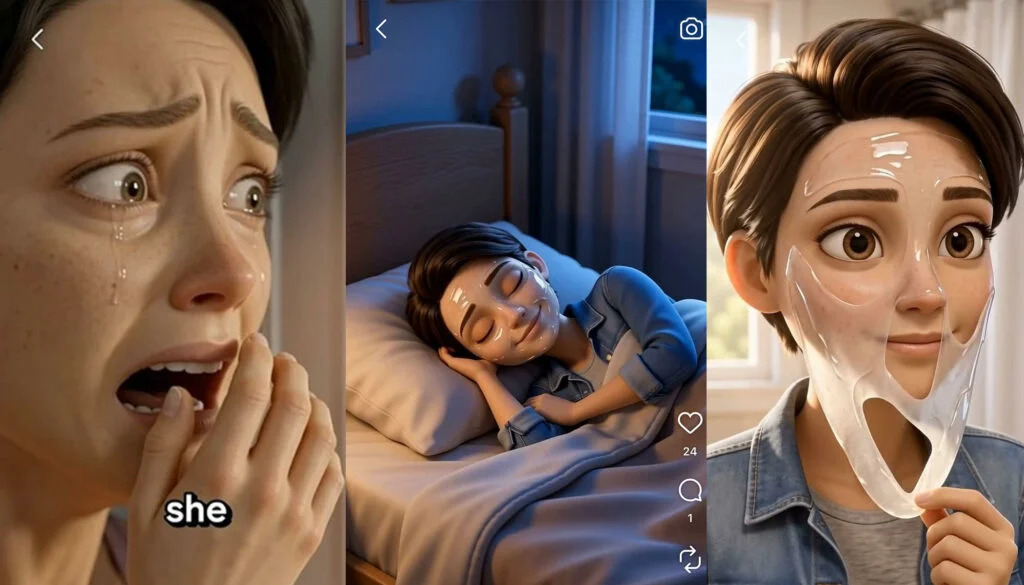
The brands running the most of these ads include Quasi, Yuri, and Koriderm, all American "K-beauty" labels. New York State law now requires advertisers to disclose synthetic performers, and these companies don't. The ads disclose it themselves. The lip sync drifts. Outfits change mid-scene. Jump cuts stutter. The tears dangle like hot glue. The script goes wonky: one woman is "fifty-three-forty" years old, and rival moisturizers "evaporate like glass." Those flaws create distance between the ad and the company behind it, which gives the brands a plausible deniability they'd lack with a human-made spot. That matters, because these ads go low, very low, even by the standards of advertising. In one, the heroine asks her daughter, "How can I be loved when I look like this?"
So whom do I blame? Is my anger even triggered? Here's the odd part. Once I clock an AWE as AI, I process it differently than I would a human-made ad. It doesn't read as a calculated snake-oil pitch. It reads as impressions, amalgamations, whispers from the ether. It's like a kid repeating what they overheard from the grown-ups. For me the word-of-machine effect runs in reverse. I'm less guarded against emotional manipulation when nobody is taking creative responsibility for it.
Going low, emotionally
These ads also go low emotionally, in ways that feel uncomfortably familiar. These women aren't just having a bad day or slightly dysregulated. They aren't the exasperated wives of commercials I grew up with, annoyed by a juice stain or quietly anxious about money. They're not even the moody brooders of soft-voiced pharmaceutical spots. These women are deep in dangerous depression, close to a perimenopausal breakdown. They grieve. They panic. They sob on the floor. They loathe themselves, want to crawl out of their sagging skin, shut themselves away from the world, and consider skipping their daughter's wedding to avoid being seen in public. Like a robot's idea of a teardrop, they're hanging by a thread.
That mix of manosphere-style gender realpolitik and midlife emotional collapse gives these AI melodramas a strange, and to me frightening, cathartic pull. Women learn early that aging can mean social death. We spend years absorbing that, and we're used to media that acknowledges how much we know about it. We tell ourselves we've made peace with it. We know it's childish and morbid to treat a natural process as a catastrophe. Then these micro-dramas come along and present a social truism as a tragic personal revelation. They offer a chance to feel, as if for the first time, the ache and unfairness of a woman's relationship to time.
The truth underneath the slop
The truth is that plenty of women I know fall apart now and then over their changing faces. The wise ones do too, often the ones who know better, because their anxiety comes with guilt about being shallow. In an odd twist on the emotionless-robot trope, AI here openly voices emotional truths. They're hackneyed, but they're also the kind of truths we've decided are distasteful to say out loud in intelligent, ethical company. We're told we are what we think and say we are, so let's not go low. But low is a real place. By going there, the robot delivers the promise of the product: it makes me feel seen. One AWE heroine sings it the morning after wearing the touted collagen mask to bed: "The moment was me alone in that mirror finally seeing myself clearly."
Every AWE claims its key moment is about self-reclamation, confidence, finally recognizing yourself. It's always about something else. The climax the story builds toward, the soaring part of the song, is the run-in with the man who left. By then the woman has been restored to her authentic, hot, younger self, and she's had her epiphany about the real problem. "It is not vanity," she belts in another pre-chorus, "it is not in your head, it is not age, your skin is starving."
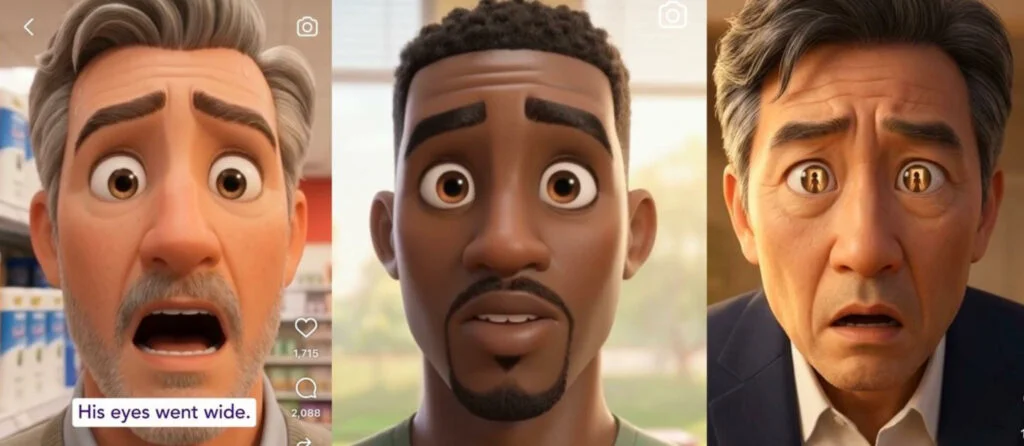
Then he appears, at the pharmacy, at daycare drop-off, at the restaurant where she's waiting for her first date in years. He sees her face, plumped and poreless as a toddler's, and his eyes bulge, his eyebrows jump, his lips fall open. He nearly does a full "awooga." He expected the old broken face and finds a "radiant woman standing tall," and he's so thrown by the change that he becomes the broken one. For a few seconds the ad lets us savor the male gaze frozen in a fit of "humina humina" stupidity. Then the woman dutifully disclaims any wish to win him back, does a little I-did-this-for-me shuffle, and lands on the "buy now while supplies last" close.
My own run-in
I had my own version of that moment recently. I was alone at a beach in New York City. I'd been there a few hours in nice weather, but when a mass of dark clouds rolled in, I packed up and fast-walked the dune path toward the exit. Around a bend, just ahead of me, was the man who left two years ago. He was walking close to someone, close enough that their arm hairs nearly touched. "Hi," I said to the backs of their heads. They stopped and half turned.
Unlike the men in the ads, he didn't look surprised. His companion took my appearance in stride, too calmly. I wondered whether they'd spotted me earlier, from a distance, and had been trying to avoid me, only to get flushed together by the storm.
We reached the end of the path as I called out. There was an opening in a chain-link fence where you leave the dunes and cross a field to the road. The woman, tall, muscular, and at least ten years my junior, stepped aside and detached herself, as if we were in a museum and she'd wandered over to study a painting on the far wall. I waved, and she gave me a strained smile while he knelt to tie his shoes.
I stood there saying things I can't remember. From his crouch, he seemed to be apologizing. I'd have to forgive him for being too distracted to talk properly, because he'd recently watched a video of someone getting struck by lightning and was now afraid it could happen to him, right here, right now. He gestured at the approaching cloud shelf. In that moment, his fear struck me as perfectly rational.
The rest unfolded like a nightmare. Now I seemed to be the one apologizing. I didn't want to make them uncomfortable. I could cross the field separately. I turned to leave, then after a few yards surprised myself by turning back and yelling, "Peace!" fairly aggressively. "Peace!" He couldn't hear me, so he stood up and jogged toward me. "It doesn't have to be weird," I said, almost as a jingle. The young woman walked up to join us, he finally introduced us properly, and we shook hands. The three of us walked abreast toward the clouds coming to meet us. I mentioned where I was headed that evening, and she said she knew the place. I nodded eagerly, "yeah, yes!" I was so grateful she'd backed me up. "Your shoes are untied," she told him, "just letting you know." We all looked down at his laces dragging through the grass. "I have to pee," she said suddenly, and peeled off toward the low concrete restroom building in the middle of the field. He stopped, I kept walking, and then the rain started: a few cold drops, then a torrent, sheets of it, a hydrating mask over the entire scene. I broke into a run for my car a few blocks away, got in soaking wet, and pulled the door shut.
Getting more alive
We want the people who left to see how much we've improved. If loving them made us better, losing them made us better still. We're tougher now. We have more colors to paint with: long, dark sorrows and neon joys. We're more alive than we've ever been. That's the part of getting older that surprises me most. I keep getting more alive. To droop outwardly and look tired at this stage would be such a perverse failure of representation that you can't help suspecting some intelligence behind it. You'd feel contrapasso, punished for the crime of caring how you look.
The Intelligence is supposedly becoming more alive too, or at least more autonomous. The warning I keep hearing is that what we should fear, not someday but next year, maybe this year, is "recursive self-improvement." That could erupt into violent agency and turn on us like a smitingly beautiful, fifty-three-forty-year-old ex-wife whose power we underestimated. "This is what you get," it says, "for thinking you could watch me ironically."
The mask in the bag
"What's that?" my daughter asks, eyeing the pink box I'm holding. Its logo looks like the killer's mask from Scream.
"It's just something for my face," I say. "To make my skin better."
"Don't use it," she says quickly, shaking her head. "Don't believe that kind of thing." When an ad interrupts something we're streaming, she'll often tell me what problem it just invented so it can sell us the fix.
"Mom, for real," she says. I can see she's genuinely anxious about the mask. I think about how frightening it would be for her if it worked as advertised and made me unfamiliar to her.
"You're right," I say. "You're so smart. I shouldn't have bought it. I won't use it." I pick it up as if I'm going to throw it out, then slip it under a stack of books in my bedroom, for some night when she's at her dad's.
Discussion
Sign in to join the discussion.