Elizabeth Glaessner explains how a childhood drawing became the nearly seven-foot painting Big Head, and why she titled it with a joke.
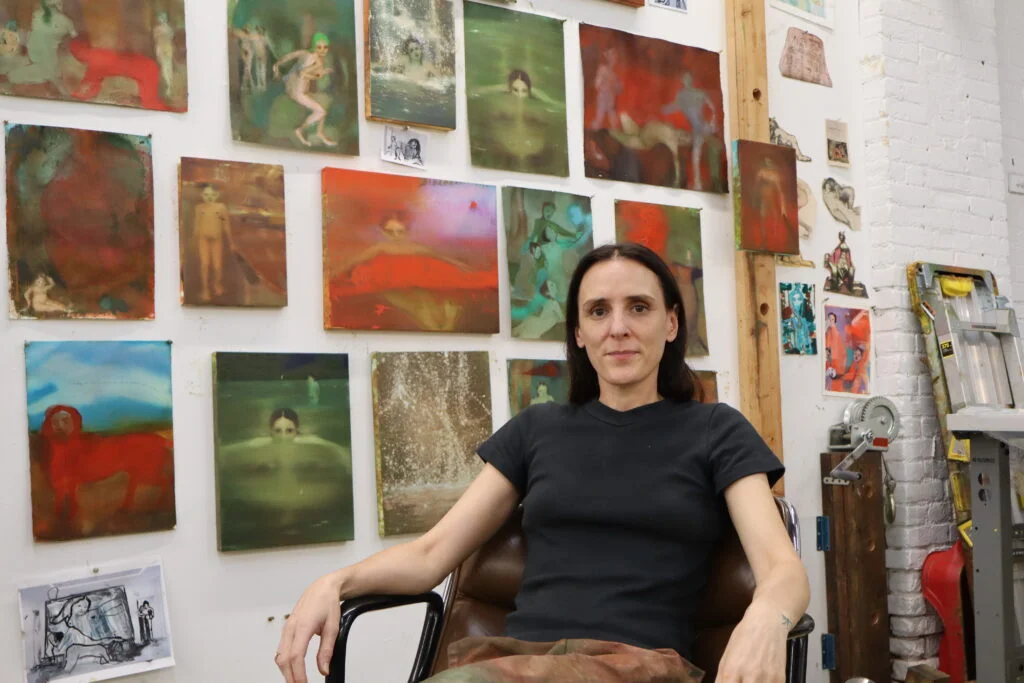
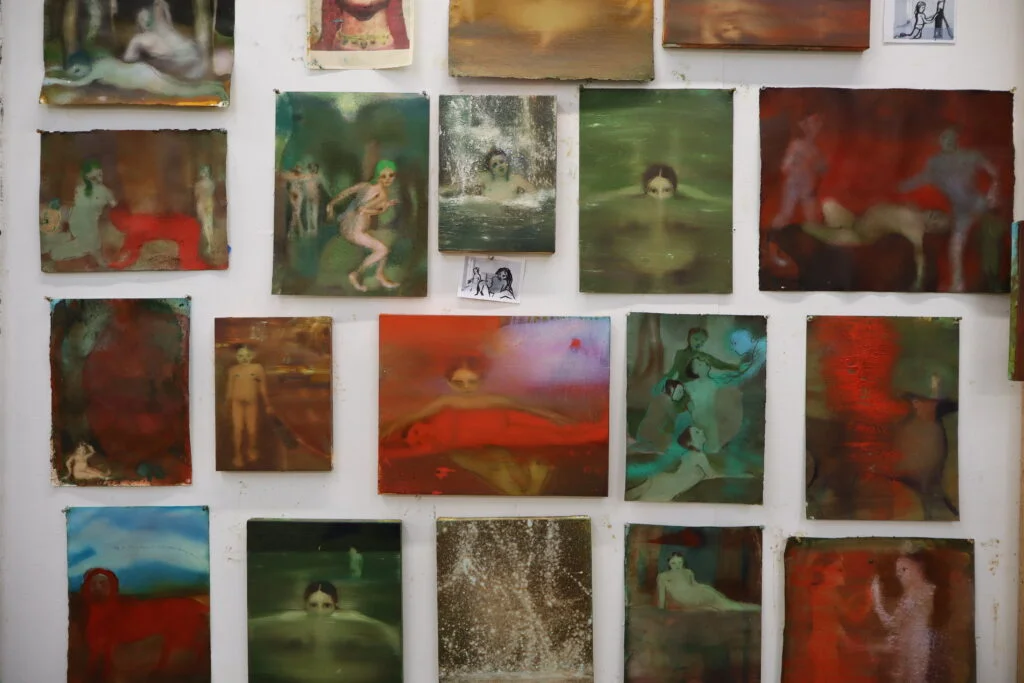
Elizabeth Glaessner's Big Head is nearly seven feet tall, which is a lot of painting to fit on a magazine cover. For our fall issue, we shrank it to roughly six inches by five. I visited Glaessner's studio in East Williamsburg to see the work at full scale, surrounded by smaller studies of the same images. She paints her motifs over and over, often with one hand braced against the wall, and the result is a scatter of multicolored handprints beside the canvases.
A Drawing About Fear
The painting began as a drawing of a small figure emerging from a mouth. The image draws on childhood experiences tangled up with fear and religion. Glaessner wanted to know whether painting could change what that imagery meant.
She studied depictions of exorcisms and cleansing rituals in painting and film, then worked from those, from the original drawing, and from memory. The small figure from the drawing returns in the lower left corner of Big Head, where it paints the mouth it once crawled out of. "What started as a memory of control and submission became a painting that was also about release and reflection," she says. That shift is the whole trick of the piece. The same gesture reads as domination or as escape, depending on which side of the canvas you stand on.
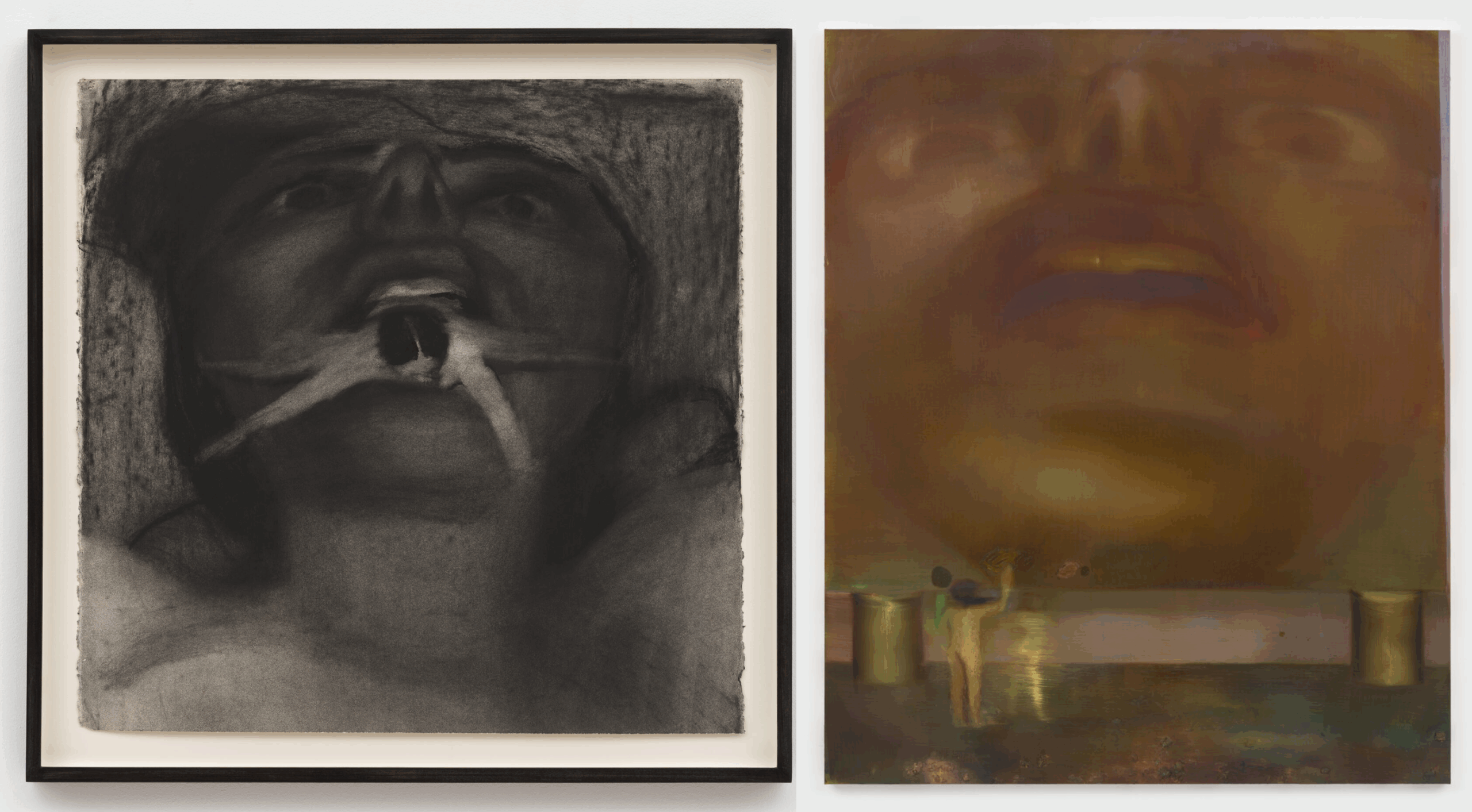
Elizabeth Glaessner, Spirit Rising study, 2025, charcoal on paper (LEFT). Elizabeth Glaessner, Big Head, 2025, oil on linen (RIGHT). © Elizabeth Glaessner. Both images courtesy of Elizabeth Glaessner and P·P·O·W, New York, photograph by JSP Art Photography.
The process changes the work along the way, and Glaessner clearly values that. When she painted the head for the last time, she was thinking about the cycle of fear, violence, and control. She was also thinking about how absurd it is for a tiny figure to paint a giant head in a studio. "I guess I'm always hoping to learn something through painting," she says. The pleasure comes when a painting turns into something she didn't see coming.
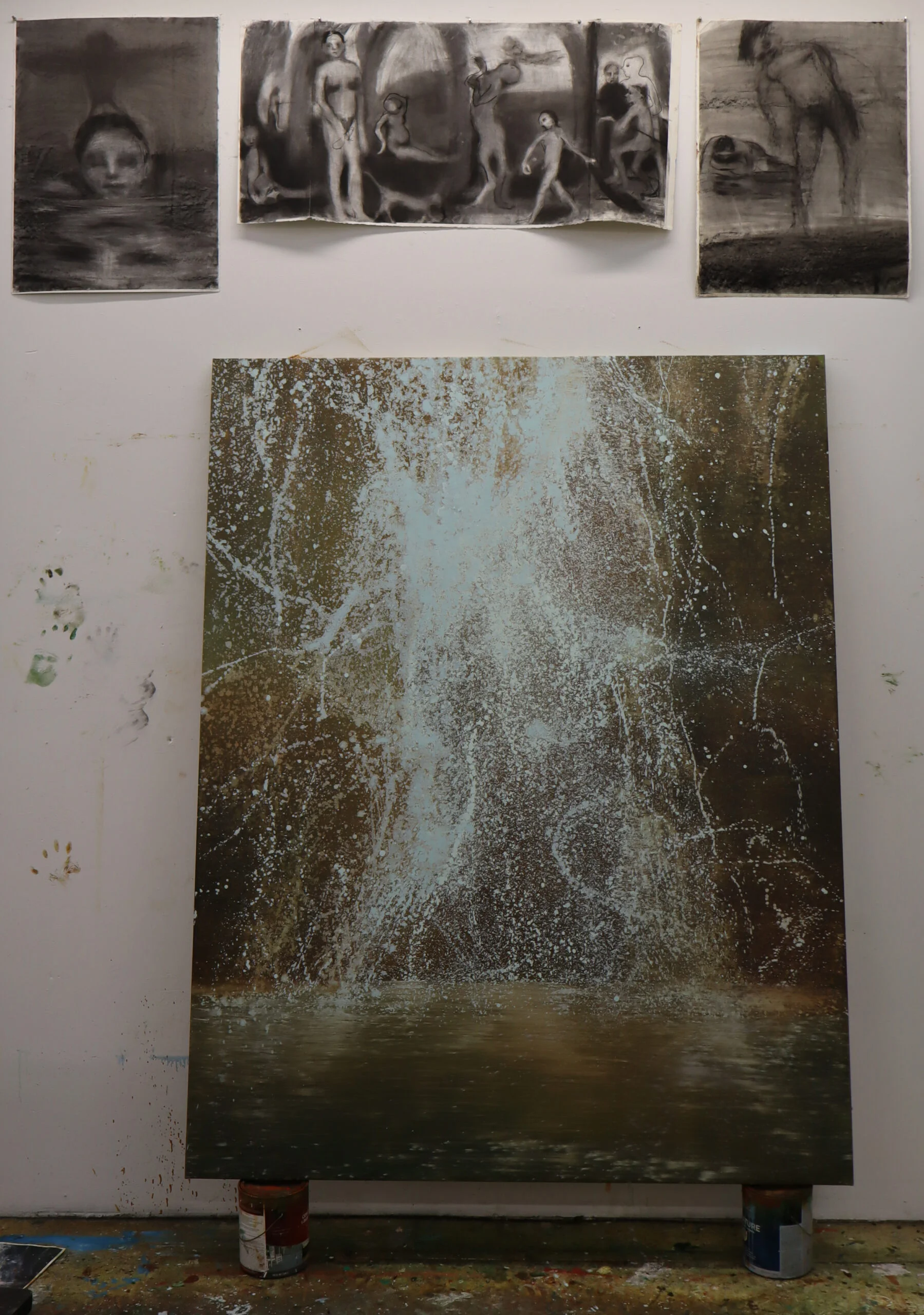
Photograph by Hazel Byers.
Porous Figures and Running Water
Water runs through this body of work. The show that included Big Head was titled "Running Water," and the phrase came partly from a Daniel Johnston song Glaessner had on while she worked. Its lyric, "Running water / Where are you running from? / You always seem to be on the run," struck her as both beautiful and sad. It described something she was circling in the paintings: constant motion that never quite gets you away from yourself.
The figures reflect that restlessness. Bodies are present, but the environment bends, stretches, and distorts them. "They didn't have autonomous borders," Glaessner says. "They weren't these closed entities. There was a lot of leaking and expelling in that show." Nothing in these paintings stays sealed off, and the forms seem to spill into whatever surrounds them.
A Joke in the Title
A painting this intense needs somewhere to breathe, Glaessner says, so she looks for room for humor. She sees titles as a chance to push against the dominant mood, and sometimes that contrast makes the mood hit harder. Big Head teases the image. A tiny person paints an enormous head, which invites a reading about ego. "I wanted to prod that idea," she says.
Music, Trance, and the Nightstand
Her studio playlist changes with the work. She used to listen to audiobooks and news podcasts, but lately it's mostly music. Smaller drawings and paintings call for ambient sound that lets her concentrate and hear her own thinking. Larger pieces get whatever album puts her in the right frame of mind. When a session goes well, she replays that album until the painting is finished. "It helps me get into this trance state," she says.
Her reading is a bit more unsettling. She has just started Osamu Dazai's No Longer Human, which she expects to explore alienation, or what it feels like to be human without feeling it. "We'll see," she says. Given how much of her work circles around the thin border between self and surroundings, it's a fitting pick.
Photograph by Hazel Byers.
Glaessner's work asks what a figure owns and what it gives up. For a painter who keeps returning to the same images, the most interesting question may be which ones she'll paint next, and what they'll have learned by then.
Discussion
Sign in to join the discussion.