Hot sauce, tinned fish, and artisanal jam now crowd the holiday calendar aisle. Brands are discovering that food makes a cheaper, more playful entry point than beauty boxes.

Food has muscled its way into the Advent calendar, and chocolate no longer owns the category. This year's lineup includes hot sauce, tinned fish, coffee, and jam, and the brands behind them are finding that the format rewards experimentation. My read is that the calendar has outgrown its original purpose, and the companies that noticed first are now setting the pace.
Experts point to a few forces driving the trend. Consumers want small treats and micro-indulgences in an expensive market. Shoppers like the idea of saving on high-value bundles. And there's the sheer pleasure of opening 25 little boxes between December and Christmas, one reveal at a time.
Chocolate still anchors the shelf
Advent Center, which tracks data and reviews for thousands of calendars worldwide, counts around 250 food and drink calendars on the market this year. That's roughly a third of the 2026 calendars it lists. Founder Max Zeshut says the category works because it's a cheaper, noncommittal entry point into the ritual than, say, a beauty box. You can try one without much commitment, and that lowers the barrier for first-time buyers.
Chocolate hasn't gone anywhere, though. For all the zany new versions, chocolate calendars remain the anchor product, the reliable baseline that the newer entrants are building around.
Newcomers testing the format
Several first-time entrants launched calendars this season. "There's something so special about having a small treat to look forward to each day," Sockerbit founders Florence Baras and Stefan Ernberg said in a statement. Sockerbit, a Scandinavian candy brand, is one of several newbies in the food calendar space this year.
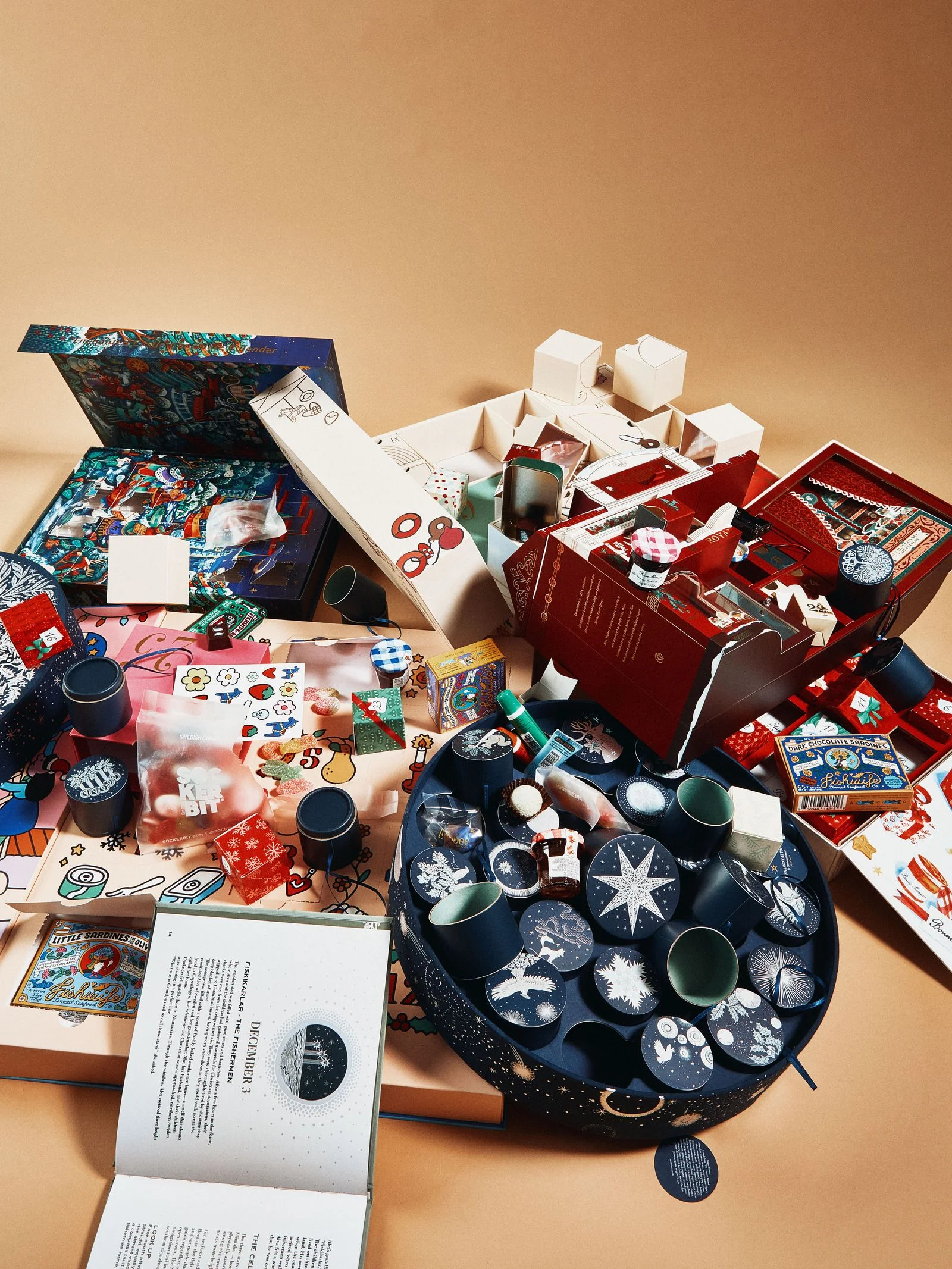
Fishwife, the tinned fish company, took a bigger leap. Its calendar packs 12 doors of tinned fish and extras and retails for $150. Co-founder and CEO Becca Millstein told Bon Appétit that the team is small and conscious of the operational load of every launch. "Still, the demand [for calendars] grew too loud to ignore, so we decided to go for it." The company credits its success in online gifting for the decision, and says the calendar's "elements of surprise and delight" fuel chatter and user-generated content on social media. "In the end, we simply had to do it," Millstein said.
Demand, repeat buyers, and the Bonne Maman effect
Money is flowing into the category. Accio, a B2B sourcing platform, estimates the global Advent calendar market will grow from $1.32 billion in 2024 to $2.47 billion by 2033, and food and drink calendars account for a large portion of that. Bonne Maman has done much of the heavy lifting. Its annual calendars have inspired "Jamvent" fan groups for a decade, and its development team starts planning two years out, studying seasonal ingredients and market trends to produce 24 limited-edition jams and spreads. A company spokesperson says the calendar sells out every year and that production has grown 400% since 2017. This year marks its 10th anniversary.
Smaller brands are seeing similar patterns. Sichuan condiment maker Fly By Jing's 2024 calendar sold out in about a month, which founder Jing Gao took as a signal. She says 65% of this year's calendar buyers are new customers, and that historically about 20% of calendar purchasers go on to buy another Fly By Jing product before year's end. "To me, that really speaks to the power of discovery and giving people a chance to explore our flavors in a fun, unexpected way," Gao said.
Onyx Coffee Lab, based in Arkansas, is betting on education. Its box holds 24 different coffees, each in a 56-gram package of whole beans, roasted on a schedule so each one peaks on its reveal day. "Advent gives us a unique opportunity to explore those things in ways that might not make sense within our everyday offerings," co-founder Andrea Allen said.
Where the ceiling might be
So have we hit the limit? Zeshut doesn't think so. "The clearest sign of demand is that people search for calendars that don't exist," he said. "There's no official Monster Energy calendar this year, and 'monster Advent calendar' is still one of the most searched terms that brings people to our site." His conclusion is blunt: "I don't think we've reached peak calendar, but we may have reached peak chocolate."
That's the number to watch. If unofficial demand for calendars nobody makes keeps climbing, the category has room to expand well beyond the usual sweets. The brands that win the next few seasons will likely be the ones that treat the calendar as a product in its own right, with a story, a reason to reopen the box, and something worth posting about.
Discussion
Sign in to join the discussion.