MJ Lenderman credits Harry Crews with shaping his songwriting, and his reading of Body shows why the novelist's ugliness and tenderness still hold up.

Lenderman's most useful mentor isn't a songwriter. Harry Crews was a novelist who filled his books with violence, sex, and grotesque characters, and whose sentences were sharp enough to make a young musician rethink what a song can get away with. Lenderman found him the way many readers do, by word of mouth, on a friend's front porch late at night in Asheville, North Carolina.

MJ Lenderman. Photograph by Sol Procter-Tarabanov. CC BY-SA 4.0, via Wikimedia Commons.

Dialogue that sounds like somebody's uncle
The friend who handed him Crews was pitching a mid-seventies masterpiece, A Feast of Snakes, set in Mystic, Georgia. The hook that actually got Lenderman was The Knockout Artist, published about a decade later, which follows a young man named Eugene Talmadge Biggs who knocks himself out for paying spectators. Lenderman ordered that book and a stack of others the next morning, including a collection that carries Crews's memoir A Childhood and the novels The Gypsy's Curse and Car.
What hooked him was the voice. The dialogue felt unforced, and the Southernness was thick without being decorative. Crews's Georgia wasn't a place Lenderman had seen first-hand. It was closer to a funhouse mirror of his own region, full of people he could imagine living next door. That's a hard effect to pull off. Most writers either romanticize rural life or sneer at it. Crews did neither, and he made the people feel like neighbors even when they were behaving terribly.
A holler, a landlord, and a rent that never went up
When Lenderman read these books, he was living at Haw Creek, a mountain holler outside Asheville that functioned less like a band house than a compound. A few houses sat close together, and friends and bandmates lived, worked, and barbecued there. Gary King owned the property and lived on it too. He recited dirty limericks in his kitchen, smoked Pall Mall Blues while hooked up to oxygen, and parked outside to lean on the horn just to needle the tenants. He also treated them like grandchildren and never raised the rent. Lenderman says those are the kinds of characters Crews taught him to see clearly, the people who are infuriating and loving in the same breath.
The pandemic then cleared his calendar. He stayed home, played music, read, and wrote, and he calls it the most devoted and formative songwriting stretch of his life. Crews was a big part of it. His girlfriend at the time, and future Wednesday bandmate, Karly Hartzman, gave him several Crews titles he didn't own yet, some signed. He also found an index of Crews's interviews that worked like a self-help manual for songwriters.
The most useful thing in those interviews was a lesson about failure. Crews was born to tenant farmers in Bacon County, Georgia, a name he could have invented for a novel if it weren't real. He had almost no advantages as a young writer and taught himself, and he kept going when nobody was paying attention. He argued that any artistic pursuit depends on your ability to withstand failure. Lenderman says that landed hard. Crews can read like a hard-ass, but that advice was vulnerable. The point was that you have to put the idea on the page before you can know whether it's any good.
Writing as an act of nerve
That idea arrived while Lenderman was writing what became Boat Songs, the record that first got people outside Asheville to pay attention. He knew some of those songs could look silly on paper. They felt right anyway. Crews also described writing as an act of courage, and Lenderman found that singing those songs felt a bit like that. He says he needed that advice to make that music, and he still does.
Crews's language mattered too. His prose is specific, serious, and silly all at once. Somebody is always "hustling his balls" in one of his books, and Lenderman argues you could write a whole essay unpacking those three words. He set himself a goal of finding phrases that precise and strange, and he admits to borrowing from Crews outright. The line "Every Catholic knows he could have been Pope," from "Joker Lips" on Manning Fireworks, is one people love to quote. Lenderman didn't write it. Crews did, in Gospel Singer, published by William Morrow & Company in 1968. It's on page 209 of the first edition, toward the middle: "Every man knows that his gift will set him free if he is just lucky enough. Or unlucky enough, depending upon your point of view."
Body is absurd, and that's the joke
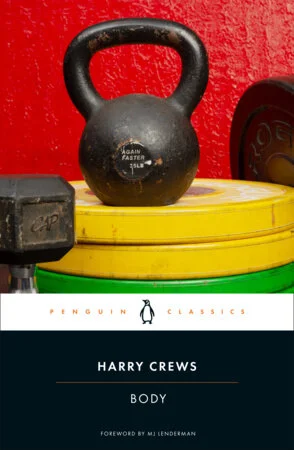 The passage reminds Lenderman of Body, a book that looks on the surface like a bodybuilding standoff between Shereel Dupont and Marvella Washington. Marvella is an imposing Black woman from Detroit. Shereel is a small, sculpted white woman from Waycross, Georgia, so rural her name used to be Dorothy Turnipseed. But the book isn't really about them. It's about a stubborn feud between Russell "Muscle" Morgan and Wallace "The Wall" Wilson, two aging coaches who, still enormous, have one way left to win: through the women they command. Muscle controls Dupont so tightly that he makes her change her name, rations her water, keeps her from her family, and decides when she has sex with him. She only wanted to work as his secretary. He insists she become Ms. Cosmos.
The novel is ridiculous, and it's built that way. Every action, name, and figure is pushed so far it can read like a caricature. What makes Crews work is that he humanizes everyone even inside that absurd setup. A man named Nail Head turns out to be capable of real tenderness. A bodybuilder named Billy Bat, a freak of nature, finds the family and romance he didn't know he wanted with Shereel's sister, Earline, who is so addicted to food she carries spare pieces of fried chicken around. The contest at the Blue Flamingo is a hilarious shitshow, and because it's Crews, it's also full of heart.
The warning on the tin
Lenderman is upfront about the cost. Like nearly every Crews book, Body is full of vile material. Muscle and the Wall are white and Black, and the book fires racist epithets back and forth between them like volleys between North and South. Much of the sex is degrading, and the women involved have little or no say. The novel opens with a scene so brutal that Muscle wrecks the hotel furniture. The hotel manager, a man so ashamed of his terrible toupee that he won't sleep with a woman who might see him without it, hires and fires a series of secretaries he calls only "Miss Beverly," who perform oral sex under his desk on demand.
That's the difficult part of reading Crews, and it's worth saying plainly. He works a bit like a literary highlighter. He uses garish colors to show readers how people can actually behave, and the glare can be hard to look at. Readers who come to him for comfort will be disappointed. Readers who want a clear-eyed look at ugliness will find very little that's dishonest about it.
The ending, without spoilers
Lenderman won't give away the ending of Body, but he does say something about it. Crews likes to blow things up and exaggerate the messes people make. The final three pages, though, are a masterstroke of restraint. The reveal is so nuanced and particular that Lenderman had to read it several times to be sure he understood. Each time he has returned to the book since, he has spotted new clues, breadcrumbs Crews scattered to make the ending feel inevitable in hindsight.
That kind of construction taught Lenderman more than tricks for reading. It showed him that a writer can hold a reader's contempt and sympathy at once. His takeaway is that most people, however strange their behavior looks from the outside, are mostly trying to do their best. That's a useful reminder for anyone who writes characters or songs about people they don't fully understand.
Penguin Classics publishes Body on November 10, and Lenderman's foreword makes a strong case for reading it as a songwriter, a novelist, or anyone who wants to learn how to be specific without being precise to the point of cruelty. Start with the pages on failure, then read Body with the ending in mind. You'll likely find the breadcrumbs too.
MJ Lenderman was born and raised in Asheville, North Carolina, and is a singer-songwriter and multi-instrumentalist. His albums include the critically acclaimed Boat Songs (2022) and his breakthrough release, Manning Fireworks (2024), which was named one of the year's best albums by Rolling Stone, Pitchfork, Paste, and The New Yorker.
Discussion
Sign in to join the discussion.