Barbara Trapido recalls how a short story turned into her debut, built on rapid-fire dialogue, quiet visual motifs, and a household that never stops talking.
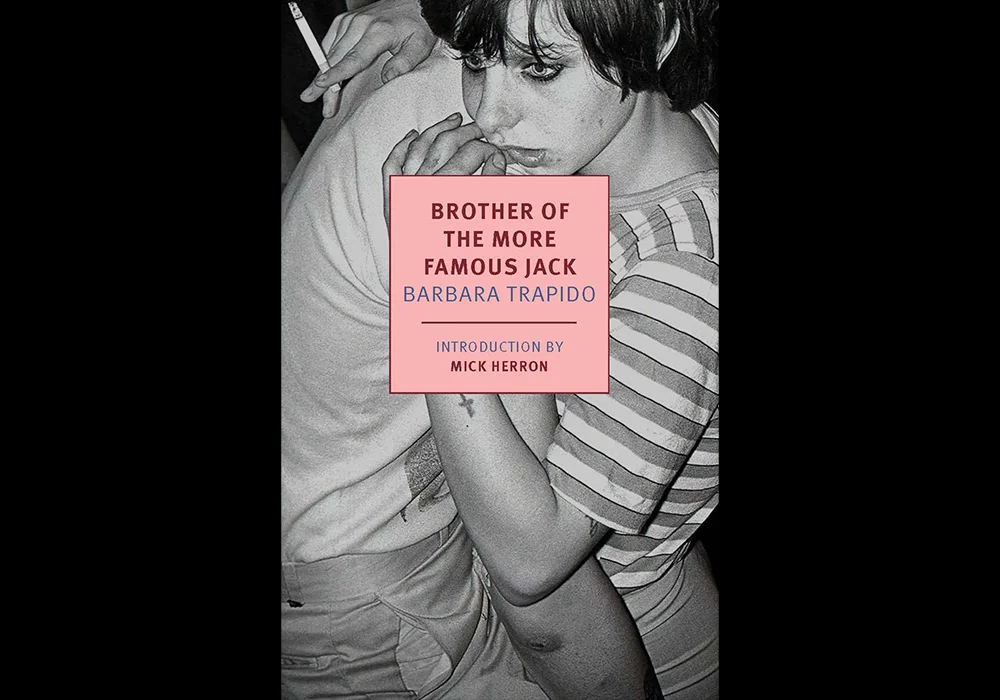
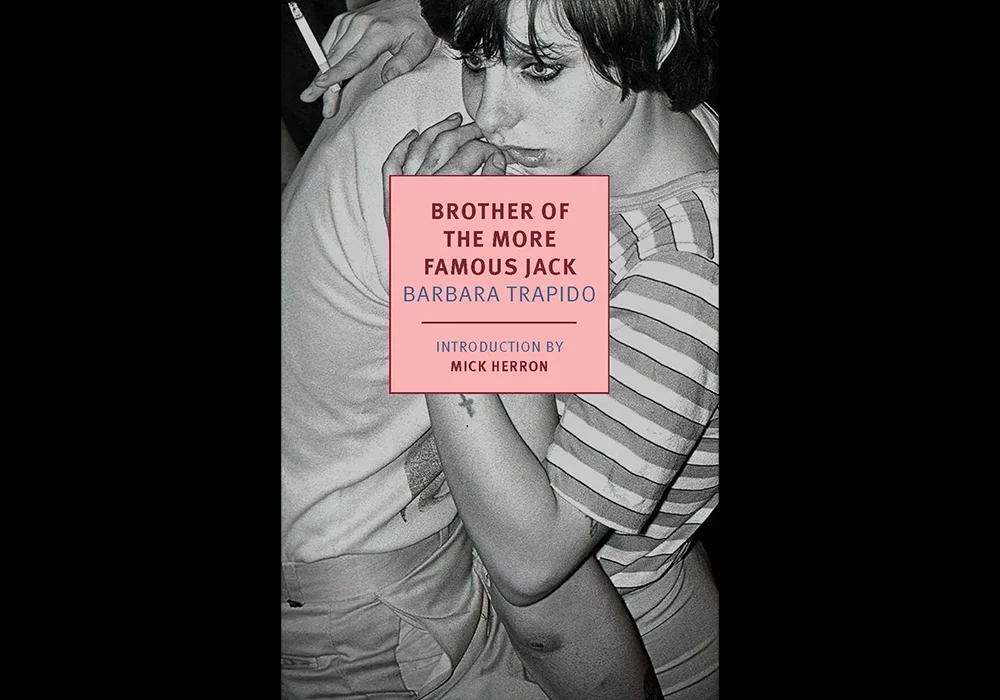
Barbara Trapido's Brother of the More Famous Jack first appeared in 1982, and New York Review Books has now brought it back into print. The book opens with Katherine, a young narrator, reading the preface to a book by her beloved professor, Jacob Goldman. The preface is a lovely piece of mischief. Goldman refuses to thank his wife, Jane, for any editorial help, on the grounds that she never gave any. He thanks her instead for her "continuing presence," something he has never presumed to expect.
I cannot in good conscience give the statutory thanks to my wife for helpful comments on the manuscript, patient reading of drafts or corrections to proofs, because Jane did none of these things … Since custom requires me to thank her for something, I thank her instead for the agreeable fact of her continuing presence which in twenty years I have never presumed to expect.
Katherine insists that the preface shaped the paths she chose to tread. Plenty of readers would say the same about the novel itself. Some of my own habits, from my handwriting to my fondness for certain dress codes, feel so tangled up with the book that I can't say where the novel ends and my taste begins. That tangle is the best argument for the book's staying power, and it's a useful place to start a conversation with its author.
A novel about how to live
Brother of the More Famous Jack reads less like a plot and more like an instruction manual for living. It covers how to be happy, how to grieve, how to fall in love, and how to fall apart when love doesn't hold. It also covers what to wear, what to cook, and what to buy an overconfident sixteen-year-old boy for his birthday, which in this case is a bicycle bell.
Katherine is a well-mannered, middle-class girl whose suburban life is upended when she falls in with the Goldmans. The household is enormous. Jacob is a Marxist professor with a remarkably hairy chest. Jane is a beautiful, posh wife who both adores and resents motherhood to six unruly children. The two eldest boys, Roger and Jonathan, drive much of Katherine's emotional education. The whole family is loud and combative, and they are sophisticated without seeming to care about it. Books, music, politics, sex, and money get discussed at full volume over dinner. Katherine's life is never quite the same afterward.
Lunch, tomatoes, and a voice from the page
I spoke with Trapido at her house in Oxford, and within minutes I understood why her dialogue crackles. While she made lunch, she offered me "some dear little tomatoes." It's the kind of phrasing that sounds rehearsed until you realize it's just how she talks. We covered how she structured the novel, the first time she heard someone say "fuck," and the afternoon someone mistook her for Doris Lessing.
No shape, just episodes
I asked whether she had pictured the book's architecture before she started. Her answer was blunt. "No. I saw no shape. The book is entirely character-based. It progresses via vivid dialogue. Story-wise, it's simply one episode after another."
The project began as a challenge. Trapido was in the middle of an anecdote when a friend told her she was wasting her talent by talking her stories out instead of writing them down. Trapido was stung, since she felt she was already working hard. She was teaching in the Sunderland docklands and commuting on two buses from Durham. The friend suggested a story for the Guardian short-story competition, and Trapido agreed to try.
The story wouldn't stay small. Once the Goldmans existed, she couldn't leave them alone. She wrote in the middle of the night in a hidden corner of the house. Her husband, Stanley, assumed she was finishing her thesis on the Pre-Raphaelite poets. She was actually "getting high on inventing dialogue." She trimmed the lines, tightened the exchanges, and sometimes arranged them on the page as shapes. Eventually she realized the piece had outgrown the form.
Even then, the shape came late and by instinct. Trapido described asking herself whether she was writing a soap opera and what would happen to these people next. The answer was a set of recurring images that worked as connective tissue: the repeated references to Monteverdi, the "Hamlet hat," the older Goldman boy's initials appearing in capitals, the embroidered butterfly, and the falsetto singing. She didn't plan them. In hindsight, she sees them as threads she spun to hold the novel together. What drives the book, she believes, is the speed of its exchanges and the pleasure of the company. "I'm surprised if people think that it has much in the way of a shape," she said.
Borrowed blueprints and invented people
Trapido insists the characters came entirely from her imagination. She has noticed that real people who wander into her books tend to come out flat, while the invented ones have weight. Katherine draws on memories of leaving school and the giddy freedom of stepping toward adulthood. Jacob and Jane are, in her words, "wholly unlike anyone I knew," though her parents gave her a working model for a cross-cultural marriage. Her father grew up poor and won one of only a handful of scholarships to Leiden University in the Netherlands. Her mother came from a quiet, comfortable Berlin family that lost almost everything during the Second World War. Both of them, Trapido says, were displaced foreigners in Cape Town.
The sewing and clothes obsession belongs to Katherine, but it's Trapido's own adolescence on the page. She spent years at the sewing machine with Vogue "Paris Original" patterns and slept in rollers to get the right waves into hair that was stubbornly straight.
A preface with a confession
Jacob's preface, Trapido admits, was a pleasure to invent, partly because it's autobiographical in spirit. She was, in her own description, one of those wives who edited and annotated, not only for her husband but for a number of academics who write in sentences that run for a paragraph. The joke lands because she knows the labor it describes.
The preface also sets up the book's larger argument about family life. Trapido sees the novel as a sort of 1970s pamphlet on progressive child-rearing, a world where people care less about respectability and tidiness. It's also a study of class, and she says her outsider status makes her something of an anthropologist. "There's quite an awareness of social class," she told me. "I think, in general, I'm completely politically obsessed, addicted to newsprint, like Jake."
Her characters are equally interested in the news, and so is Katherine, who becomes political largely because of the Goldmans. Trapido recalls a lodger who played the piano and didn't know who Ken Livingstone was, even while the Labour Party was maneuvering to replace him with Frank Dobson as mayoral candidate. She envied his freedom to ignore the headlines and think about Dutch landscape painting. Her take on English literature education is just as sharp. She remembers a graduate student insisting that a Wordsworth poem had "nothing to do with" its context, and she still thinks the socioeconomic world of the poet is essential to seeing how the verse breaks open.
Eighty pages of arguments, one long rehearsal
Trapido's process is performative. She writes by hand, reads everything aloud, and then tapes herself and talks back to the recording. She describes her plotting as choreography. She imagines a dining table, decides who sits where, and moves between chairs as she speaks each character's lines. On a train, she works out which way the seats face. Chronology takes more effort. She has to ask whether it's the right season for a meal, or whether a character can reach a town before closing time.
The manuscript lived in a box for years. After the family moved from Durham to Oxford in 1970, Trapido packed it away and let it sit, busy with childcare and part-time teaching. Around 1980 she pulled it from the attic, prompted by a playgroup mother who wanted a serial. Trapido finished it in pieces. She kept rewriting for about a decade, and when she was about forty she was still editing madly. A friend who typeset for Gollancz urged her to submit it. The publisher replied within a week: "We love your novel. We'd like to publish it. Tell us who you are." Trapido was amused. Doris Lessing had recently fooled a publisher by submitting a manuscript under another name, and Gollancz wondered whether Trapido was doing the same. In a sense, a decade of polishing had made her quite experienced.
The editor's changes were minimal. She corrected the spelling of "righteous" and added three commas. Trapido recalls her phoning with a question about punctuation: "Fuck off," comma, "you old cow?" The profanity came from the Goldman boys, not the women. Trapido concedes a reviewer's complaint that "the women smile and knit and the men have all the good lines." She thinks there's something to it, though she argues the women are simply more confident. They don't need to shout. Katherine, as narrator, still gets some of the best lines.
Why the book still reads fresh
Trapido has little patience for writers who name Jane Austen as their template. She does concede that Austen's energy shaped her, especially the way dialogue dances and sparkles and how quickly a scene can get moving. Her friends noticed that the novel barely pauses for scenery, and that instinct goes back to her own childhood, when she skipped anything labeled "description." Iris Murdoch's Under the Net, which she read at sixteen, stuck with her. Its wandering characters crossing Vauxhall Bridge made her think, "These are my people." Elaine Dundy's The Dud Avocado, passed along by a school friend, also left a mark.
What makes Brother of the More Famous Jack worth rereading is that it doesn't feel built. It feels lived in, like a dinner party that runs long and gets louder by the hour. Its formal looseness is the point. Trapido wrote it as play and let the play carry the book. That approach still feels fresh, and it's why readers who first met the Goldmans at sixteen keep returning, decades later, to find out what they still have to say.
Discussion
Sign in to join the discussion.