Festival America 2026 brought 60 U.S. writers to France, revealing how French readers connect with American fiction and its complicated history.
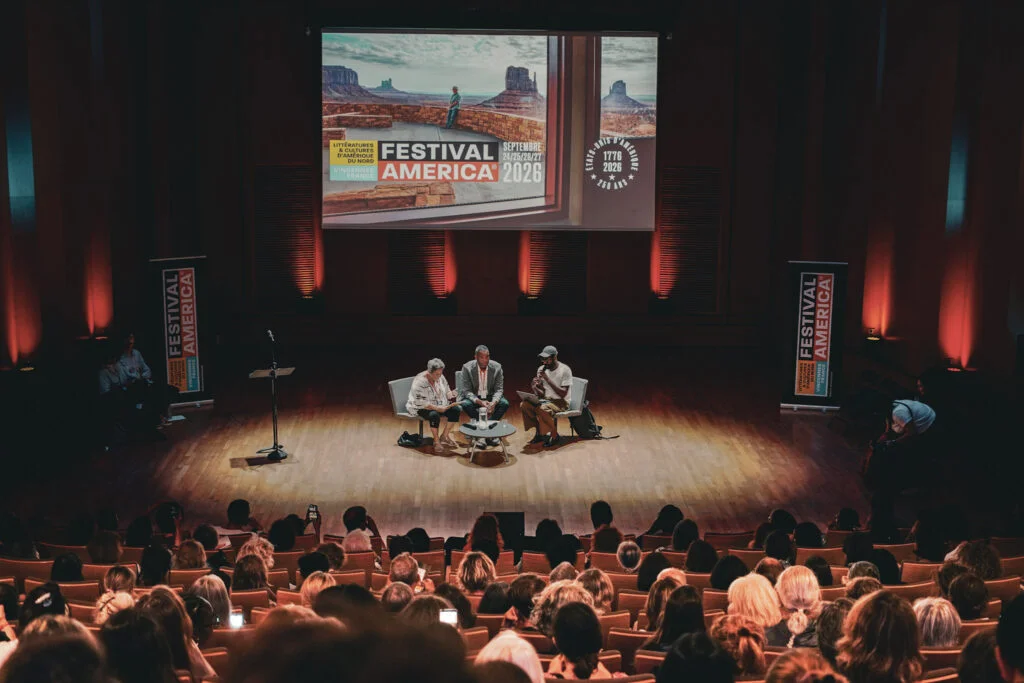
Ta-Nehisi Coates panel. © Siriot de la Petra.
A French festival looks at America
Festival America’s 2026 trailer makes the country’s past feel both monumental and brutal. Its images jump from Native American riders and George Washington to Wounded Knee, a mass grave, suffragists, Normandy, a nuclear blast, and a rocket launch. Then three lines of French text appear: Littérature. Expositions. 60 autrices et auteurs américains. Literature. Exhibitions. Sixty American writers.
The montage cuts to portraits of John Grisham, Joyce Carol Oates, Laura Kasischke, and Ta-Nehisi Coates over footage of the March on Washington. A scrolling list of sixty authors passes over soldiers heading to war. The black-and-white sequence turns to color as Ronald Reagan signs a bill and a plane hits the Twin Towers. It’s an ambitious way to introduce a literary festival—and a reminder that any account of America’s cultural story has to contend with its violence as well as its ideals.
Held every two years in Vincennes, just outside Paris, Festival America usually brings together writers from the United States, Canada, Mexico, and the Caribbean whose books have recently appeared in French translation. Its panels and workshops cross borders. The 2026 edition narrowed the focus to the United States for the country’s 250th anniversary, gathering Alison Bechdel, Tommy Orange, Viet Thanh Nguyen, Karen Russell, Patrick Radden Keefe, and dozens of other established and working writers.
My husband, Jake, was among them, and he found the invitation hard to believe. His first novel, Slime Line, came out quietly through a university press. When he signed with a New York imprint for his next book, his editor still called him a “debut author.” But a major French publisher had bought the novel, released there as Alaska Parano, and two years after its American publication we found a readership waiting for him in France. His book sat on “New and Notable” tables near our hotel and was a staff pick at Shakespeare and Company.
That enthusiasm had been reaching him online, too. French-language Instagram accounts praised the novel, which draws on his years in commercial fishing, as a beautiful account of the “solidarity of magnificent losers.” His publicist soon asked whether he’d speak with a journalist at a major French magazine for a profile calling him the “new voice of America.” The attention was flattering, baffling, and specific. I wanted to know what French readers recognized in his work.
What American fiction looks like from France
That wasn’t quite my main motivation. Journalists like to end an opening with a mission; in my case, wine and cheese ranked higher. On the festival’s first full day, authors and their guests met for a “cocktail lunch” at the Château de Vincennes, home to French kings from the fourteenth to seventeenth centuries. We ate radish skewers, charcuterie on thin bread, and small meringues beneath Europe’s tallest donjon.
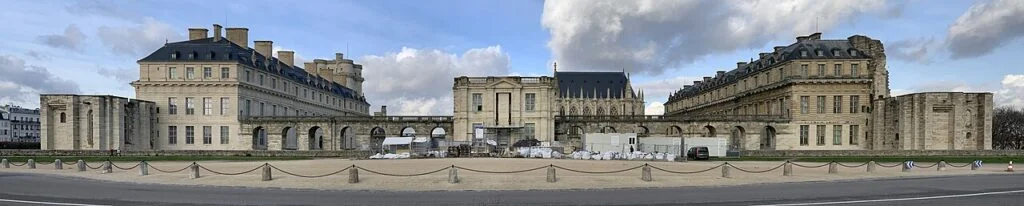
Château de Vincennes, CC BY-SA 4.0, via Wikimedia Commons.

I asked the festival’s chief interpreter whether the château had any torture instruments. She pointed instead to a more ordinary horror. In 1422, after the Siege of Meaux, Henry V of England retreated there. He had conquered Normandy and seemed close to claiming the French crown, but dysentery killed him before he could settle in.
That long history sharpens the contrast with the United States. “Compared to Europe,” Festival America founder Francis Geffard told me, “it’s very recent.” The country’s 250th anniversary offered a neat occasion for a U.S.-focused program, and Geffard hoped to bring writers from different generations, regions, and backgrounds together to ask what American fiction might mean to readers abroad.
The assignment sounds nearly impossible. But writers are rarely inclined to turn down a free trip to Paris. As Geffard put it, “It is very unusual for a writer to turn down the invitation.”
After lunch, Geffard moderated a French-language roundtable at Vincennes’s nineteenth-century town hall, the Hôtel de Ville. A red carpet led past photographs that included migrants crossing the Rio Grande. More than two hundred people filled the marriage hall; the previous festival had drawn 60,000, and the press team expected a similarly strong crowd this time.
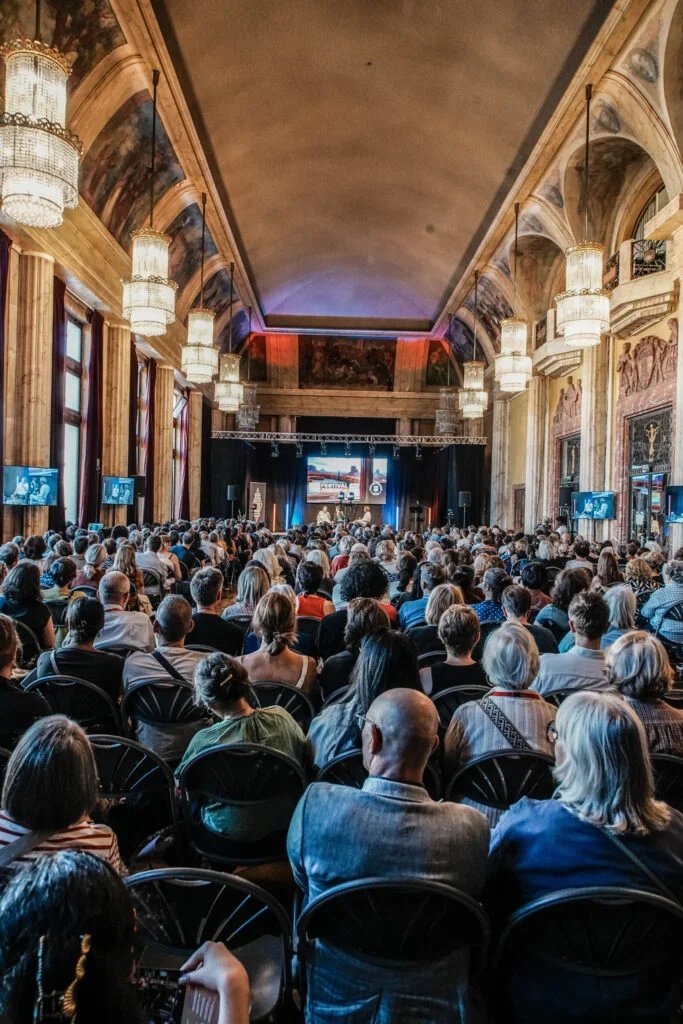
The panel began from a pair of assumptions: American writers differ from French ones, and France often imagines the United States as a country without culture. Sébastien Bonifay, a Corsican writer and bookseller who has made more than twenty trips to visit favorite American authors, offered a deliberately provocative answer. His book (Not) Born in the USA recounts visits with James Ellroy, Chris Offutt, Donald Ray Pollock, Stuart Dybek, James McBride, and others. “The literature that nourishes me,” he said, “is an American literature that Americans don’t like.”
Bonifay called it “a literature of the margins.” The panelists linked that writing to countercultures—rock and roll, psychedelia, punk—and to books outside the usual publishing centers. One described two American literatures: the coastal one and “the other,” often excellent but less often published. University presses, the panelist argued, have been vital to that work. Commercial recognition seemed beside the point; the panelists trusted their own judgment.
They also sketched a writer who could have been Jake: someone with an “American-style résumé,” fitting writing between blue-collar jobs, whose work carries the texture of lived experience. This writer “had lived,” they said, in places a French reader might struggle to picture—Ohio, for instance. That description helped explain why Jake’s fishing novel had found an audience. It also risked turning a large country into a tidy literary type.
Bonifay’s own path into American fiction began at fourteen with Stephen King. He cared less about the horror than the setting: Derry, the fictional Maine town, captivated him before the plot took hold. In (Not) Born in the USA, his pilgrimage to Donald Ray Pollock begins in a Wendy’s parking lot, where he waits anxiously for the visit. I understood the appeal. A place can be the first thing a reader falls for.
“The writers who have a lot of success in France” are often less successful at home, Bonifay said; some aren’t even published in the United States. He thinks French readers’ attraction to this work has something to do with their complicated view of America. “We are fascinated by America,” he told me. “But we truly, deeply think we should be, as France, as a country, where America is.”
France has a much longer history, he argued, and French readers are drawn to American books that expose the country’s harsher, seedier side. He pointed to Colorado noir writer Benjamin Whitmer, whose readership is larger in France, and recalled visiting him there. Whitmer owned thirteen guns and asked Bonifay about the French literary theorist Maurice Blanchot. “Benjamin Whitmer knows Maurice Blanchot,” Bonifay repeated, delighted by the collision. “He reads Maurice Blanchot, and he’s got thirteen guns.” One gun, he explained, was for grizzlies; another for coyotes.
For Bonifay, that contradiction made Whitmer more compelling. He was blunt about his preferences: “It’s just my opinion, but these writers are a lot better than the other ones. Really, I don’t care about Jeffrey Eugenides! Really, I don’t care.”
Literary taste, and its limits
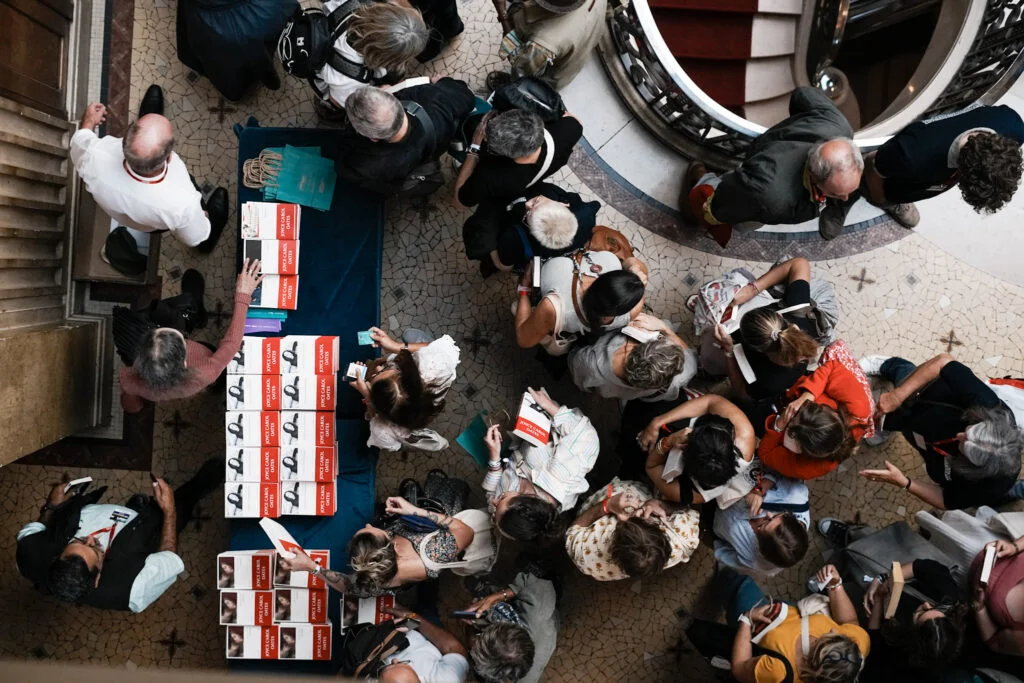
© Siriot de la Petra.
Jake, a West Virginia University Press author, was already selling books in the tent. A group of teenagers had just crowded around him after a talk. When I told him about Bonifay, he said, “That guy rules. I think he wants us to come to Corsica.”
Nearby, a queue for Joyce Maynard wound through the booths. I asked two women browsing books what drew them to American literature. The younger one named stories, journeys, and wide-open spaces, then turned the interview around and asked about my life in the United States. When I described Jake’s fishing novel, she said that kind of writer wouldn’t exist in France: “In France, it’s more l’establishment.” Her companion explained that French writers were “professionals” and guessed that a writer on capitalism might be a banker.
They told me I should understand contemporary French literature through the woman with the black hat and red lipstick, who “has her own myth.” I didn’t follow their reference to le wokisme and was too wary of my French to ask. Later I worked out that they meant Amélie Nothomb, a Belgian Francophone novelist known for large hats and television appearances, and named a baroness by King Philippe.
The festival had its own unexpected literary celebrity. Rob Franklin told me an older woman named Sophie approached him at the opening ceremony. She was around ninety, stylish, and carrying a monocle, and Franklin assumed she was his French editor, who was also named Sophie. She asked to photograph him, checked her schedule, and began a portrait session.
The next day he went to his publisher’s tent and met the other Sophie. For the rest of the festival he wondered who had taken his picture. On the final day, the first Sophie returned with her business card: she was France’s best-known photographer of writers and had been making portraits for sixty years. Her card featured a black-and-white image she had taken of Michel Foucault.
I wanted to test the talk of l’establishment with Fabienne Gondrand, a literary translator who interpreted for Jake throughout the festival. She had heard him speak on panels and translated his comments into French. When I asked whether American writers were more anti-establishment, she pushed back: “That’s a little reductive.” Perhaps, she suggested, people were using the term because the festival had brought together diverse writers, including nonwhite and Indigenous authors whose work challenges American cultural norms.
She had a point. I’d been tempted by a neat division between coastal literary insiders and scrappy writers with day jobs, and by the flattering idea that French readers instinctively preferred the latter. That reading was too convenient. The American establishment at issue here was less about geography or publishing deals than political power—and, in this case, the U.S. ambassador to France, Charles Kushner.
Since 2002, the U.S. ambassador has spoken at every Festival America opening ceremony, Geffard told me. Kushner, a real estate developer and pardoned felon, holds the post now. The U.S. Embassy usually contributes cultural funding to the festival, though less than Canada’s embassy. This year, it cut its contribution by 80 percent. Geffard saw the reduction as a sign of distrust and declined the money altogether.
Geffard said French people were “feeling a little estranged” from the United States. A festival press release put the complaint more sharply: the cut came in the 250th anniversary year, when Vincennes was hosting the largest delegation of American writers ever assembled in France, and possibly anywhere in Europe.
That gathering matters because these writers rarely appear together at home. American authors are more often grouped by subject, identity, or genre; the word “American” can feel too broad to explain much when you’re inside the country. In Vincennes, distance made the category visible. French readers brought confidence in their own tastes, shaped by a lifetime of looking toward the United States. I came home with the unusual feeling that America had been looking back at itself.
During the festival, Kushner’s embassy was advising Americans to “exercise caution.” Since then, student protests there have widened into riots. Those protests, at least, seemed aimed squarely at l’establishment.
Noelle Mateer is a journalist in Pennsylvania. Her work appears in The Guardian, The Baffler, Wired, and more.
Discussion
Sign in to join the discussion.