The Australian writer will receive the Hadada Award, recognizing five decades of fiction, journalism and essays shaped by candid attention to family life.
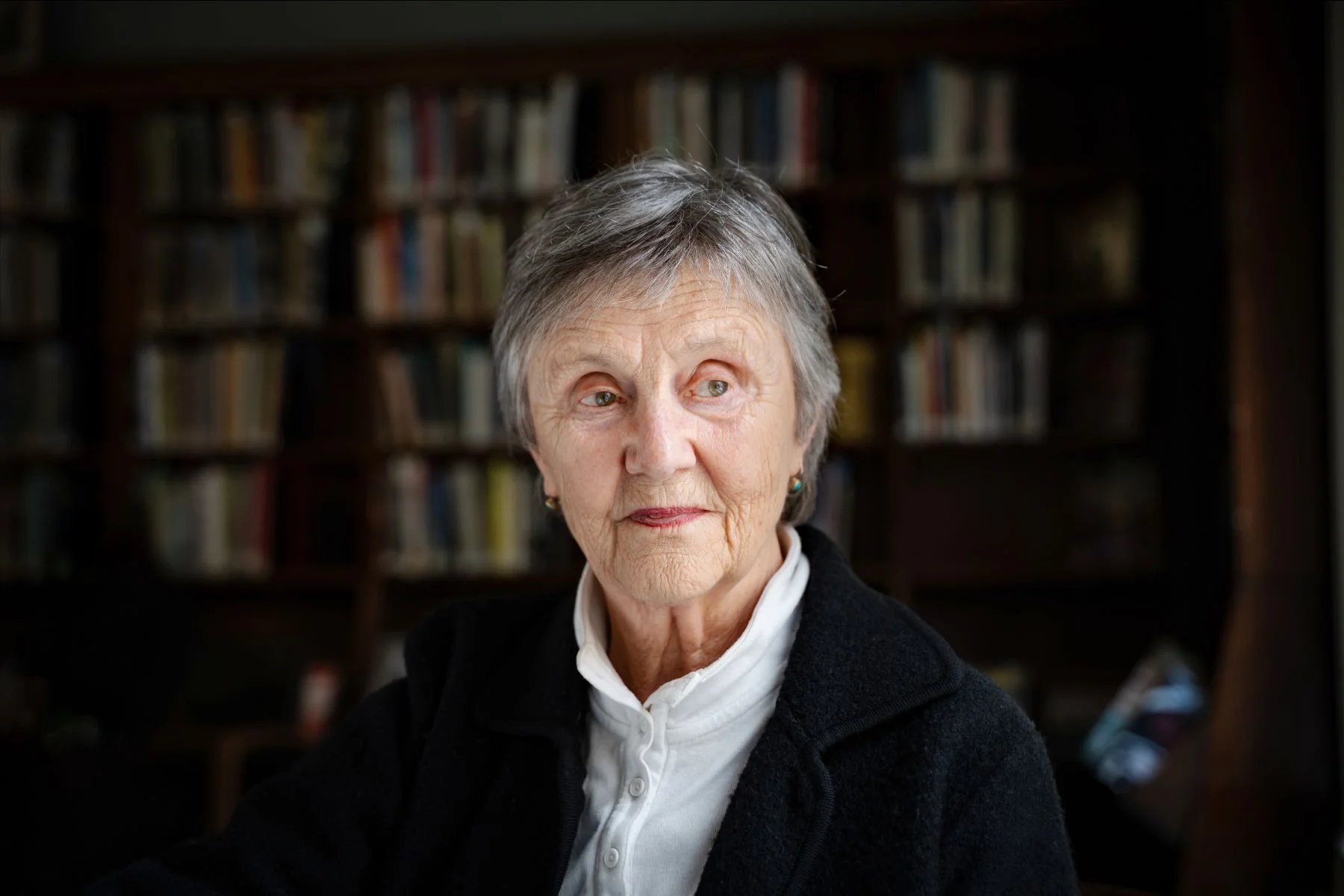
Photograph by Darren James.
Private life, made public
Helen Garner’s writing has repeatedly made private life matter in public. Her subjects include the volatile bonds between partners, parents and children, and the demands of caring for someone in crisis. Those concerns can sound modest beside the public events that often command attention, but Garner’s work argues that a household is never sealed off from the world around it. It’s where affection, dependence, power and disappointment become tangible.
That focus now anchors the Hadada Award for lifetime achievement, which Garner will receive at the Spring Revel on April 6. The award recognizes a body of work spanning fiction, journalism and essays, all marked by close attention to how people behave when they’re bound to one another. This is more significant than it looks: Garner has spent decades treating domestic life as serious material, even when some critics saw it as too small or too personal to carry literary weight.
A story while it was happening
Garner’s approach took shape in the 1970s, when she and her young daughter lived in a communal house shared largely by single mothers in Melbourne. Amid the noise, Garner read Proust and Tolstoy, kept a diary and began a relationship with a man addicted to heroin. These weren’t distant memories arranged neatly after the fact. She felt the events becoming a story even as they unfolded, and that immediacy would become central to her work.
“Story is a chunk of life with a bend in it, and I could feel this one coming,” she told Thessaly La Force in The Art of Fiction No. 255. “I suddenly thought, Maybe I could write about this while it’s still happening, as it’s coming into its bend.” The image captures both the promise and the risk of writing from life: the writer must notice a pattern before its meaning is settled. Garner’s method doesn’t make experience simple; it keeps the uncertainty visible.
A diary turned into a debut
That experience informed Monkey Grip, Garner’s 1977 debut novel. Its portrayal of unconventional domestic life, sex and female desire unsettled some critics, who accused her of publishing a journal. The charge implied that material drawn from personal experience arrived on the page without selection or craft. Garner later challenged that assumption directly, insisting that the diary itself was work, not a raw stream waiting to be printed.
“As if there were no work involved in keeping a diary in the first place,” she wrote in a 2002 essay. “It’s as if a diary wrote itself, as if it poured out in a sludgy, involuntary, self-indulgent stream.” Her objection points to a distinction that still matters in writing shaped by lived experience: closeness to an event doesn’t remove the need to decide what to include, how to describe it and where to stop. Her diaries have since appeared in three volumes, covering 1978 to 1998.
Born in Geelong, Victoria, in 1942, Garner was the eldest of six children. Reading, she said, gave her a private refuge in a busy household: “It was my way of being absent.” That childhood attention to family life carries through her fiction, where a home can offer shelter and impose demands at the same time. In The Children’s Bach (1984), a couple’s contained world is unsettled by a bohemian family; in The Spare Room (2008), the focus shifts to the strain of caring for an old friend pursuing alternative cancer treatment.
Family life, under pressure
Garner has also brought her attention to nonfiction, particularly in books about murder trials. Joe Cinque’s Consolation (2004) follows the case of a young woman who killed her boyfriend. This House of Grief (2014) recounts the case of a father who drove himself and his three children into a dam, killing them. In each book, the facts of a case sit alongside questions about the relationships around it: what people understood, what they failed to see and how responsibility is examined after violence.
“The thing is, despite being told that my concerns were too domestic, I’ve always known that the family is where everything is played out,” Garner told La Force. That claim gives her work a wider reach without asking it to leave the household behind. Family ties are intimate, but they’re also structures of care and obligation; when those structures break, the effects aren’t private in any simple sense. If you’re working in this space, Garner’s example is a reminder that the ordinary setting can hold difficult moral questions without turning them into abstractions.
A long record of close attention
Across five decades of fiction, journalism and essays, Garner has built a body of work marked by emotional precision and unsparing observation. Her honors include the Windham-Campbell Prize, the Melbourne Prize for Literature and the Walkley Award; she has also been inducted into the Victorian Honour Roll of Women. The Hadada joins a roster of past recipients that includes John Ashbery, Anne Carson, Deborah Eisenberg, Jamaica Kincaid, N. Scott Momaday, Edward P. Jones and James Salter.
That list places Garner among writers recognized for work with lasting literary influence, while her own subjects remain insistently close to home. The numbers here are underwhelming as a measure of what she’s done: prizes can mark recognition, but they can’t explain why a writer’s attention continues to matter. Her achievement lies partly in the persistence of the subject itself. Family life, seen clearly. And the consequences that follow.
What the award recognizes
The award will be presented at the Spring Revel on April 6. Garner’s recognition reflects the force of a literary practice that has treated domestic experience as a place where larger human conflicts come into view. That said, the honor’s significance rests less on a single ceremony than on the work it gathers together: fiction attentive to desire and care, and nonfiction willing to stay with painful cases rather than flatten them into summaries.
Here’s the thing: writing about private life can be mistaken for writing about a narrow one. Garner’s career pushes against that assumption by showing how much can be at stake in a relationship, a household or an act of care. And yet her work doesn’t promise easy lessons. It asks readers to look closely, remain uneasy when the evidence is complicated, and accept that a story’s meaning may arrive with a bend in it.
Discussion
Sign in to join the discussion.