August Wilson argued that Black theater’s specific cultural detail can speak across racial lines, while jazz, rap and family memory help carry tradition.
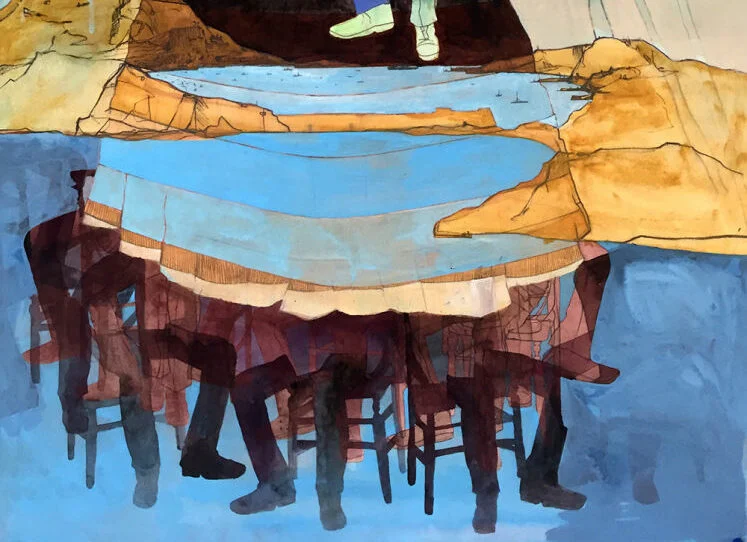
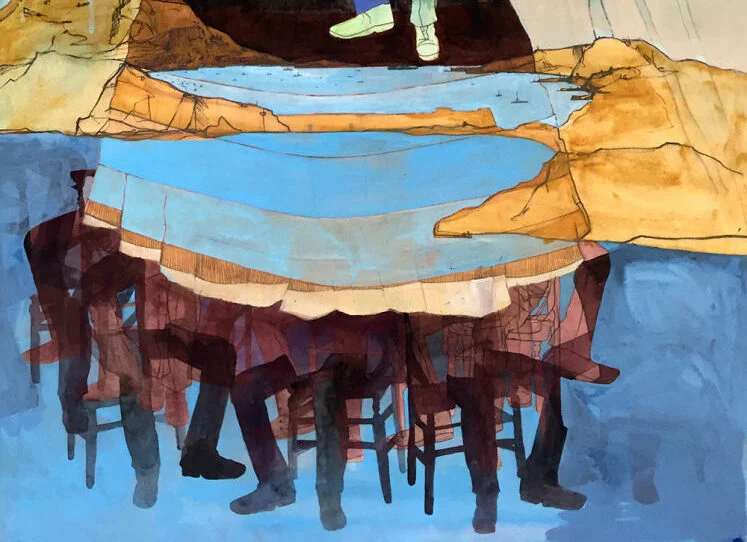
Pamela Phatsimo Sunstrum, Sentinel, 2018. From a portfolio in issue no. 232.
Specific lives, shared recognition
August Wilson’s plays ask audiences to recognize Black life on its own terms, then reckon with how much of that experience belongs to a shared human world. In a 1999 interview, the playwright described the tension between cultural specificity and broad recognition without treating either as a compromise. The distinction matters: a story can be rooted in a particular community without being sealed off from everyone outside it.
Asked whether White audiences might struggle to connect with Black theater, Wilson said he believed they could appreciate his plays. Their characters’ social manners and circumstances may differ from an audience member’s own, he argued, but they remain recognizable as part of human conduct and endeavor. That claim rests on the particularity of his work: Wilson put Black garbage truck drivers, cooks and ex-convicts at the center of the stage, giving their speech and lives the weight often reserved for canonical figures. The audience isn’t asked to treat those lives as symbols before seeing them as lives.
His answer also points to the larger challenge running through his writing: the presumed divide between what is Black and what is human, or between Black art and art. The stage makes that challenge especially charged. For Black Americans, public performance has a history that reaches back to the auction block; Wilson’s theater takes up that history while making room for characters whose lives can’t be reduced to it. The result is a theater that acknowledges historical pressure without making history the only thing its characters are allowed to mean.
Artistic work, political consequences
Wilson rejected the idea that he wrote in order to produce social change. “That’s not why I write,” he said. “I work as an artist. All art is political in the sense that it serves someone’s politics.” The distinction is useful: he claimed the freedom to make art on its own terms while recognizing that no art stands outside the forces and interests that shape public life. It’s a position that leaves room for artistic intent and public consequence to coexist, even when the writer doesn’t set out to deliver a political program.
Playwriting appealed to him because of its audience. Wilson began as a poet, but the theater gave him a collective response that a page couldn’t. “The communal nature of the audience is like having five hundred people read your novel and respond to it at the same time,” he told George Plimpton and Bonnie Lyons. “I find that thrilling.” His plays’ public life, in that sense, is part of their form: each performance brings a room of people into contact with the same language and choices. A theater audience doesn’t respond as a single mind, though; the shared event makes room for disagreement, recognition and silence at once.
Here’s the thing: the audience’s presence changes the stakes of a story. A character’s words aren’t only received privately, as they might be on a page; they’re heard alongside other people’s reactions, in a room where attention itself is shared. That doesn’t guarantee agreement or understanding. It does make the act of listening part of the encounter.
Tradition carried close to home
Wilson was less concerned about Black culture disappearing than about a break in the traditions that connect generations. He pointed to historically Black colleges where, at convocation ceremonies he had attended, students sang Bach rather than gospel. He found a stronger connection to Black aesthetics and tradition in jazz and rap. His concern wasn’t simply with a choice of music; it was with what gets carried forward, and whether young people can recognize the cultural inheritance around them.
That said, the example shouldn’t be mistaken for a simple argument against Bach or for a fixed test of cultural authenticity. Wilson was describing what he heard as a gap between institutional ceremony and the traditions he believed had shaped Black cultural expression. Jazz and rap, in his account, offered a more immediate connection. The broader question is how communities pass down artistic forms when education, family and public life each tell different stories about what counts as cultural knowledge.
His account of a conversation with his daughter makes the point more personally. She called from college excited about joining the Black Action Society and studying Timbuktu. Wilson welcomed her interest, then urged her to study her grandmother and trace that history back through her own family. His point wasn’t to dismiss Africa, but to insist that the route to ancestral history runs through the lives and knowledge passed down at home. “You don’t have to go to Africa to be an African,” he told her. “Africa is right here in the southern part of the United States.”
That exchange is also an argument about where historical knowledge begins. A distant origin can matter deeply, yet it can feel abstract if the family stories that connect people to it go unheard. Wilson’s emphasis falls on the intimate record: what a grandmother remembers, what a family repeats, and what a younger generation chooses to ask. The point is not that one source of history replaces another. It’s that inherited knowledge becomes tangible through people.
What the argument asks of audiences
Wilson’s view of cultural continuity begins with the people and practices nearest at hand: family memory, music and community. His theater follows the same logic, making particular Black lives the material through which audiences encounter both a distinct history and recognizable human experience. That approach places a responsibility on the audience, too: to meet the characters on their own terms rather than demanding that they stand in for an entire community.
This is more significant than it looks. The interview links two ideas that are often pulled apart: cultural specificity and artistic reach. Wilson suggests that the work doesn’t need to dilute its setting or language to become legible; audiences can do the work of listening. If you’re working in this space, that’s a useful standard for criticism as well as theater: ask what a work makes visible before measuring it against someone else’s experience.
And yet. Recognition isn’t the same as full understanding. A performance can open a door, but the audience still has to decide whether to cross it with curiosity rather than assumption.
The work of listening.
INTERVIEW
The Art of Theater No. 14
August Wilson
Discussion
Sign in to join the discussion.